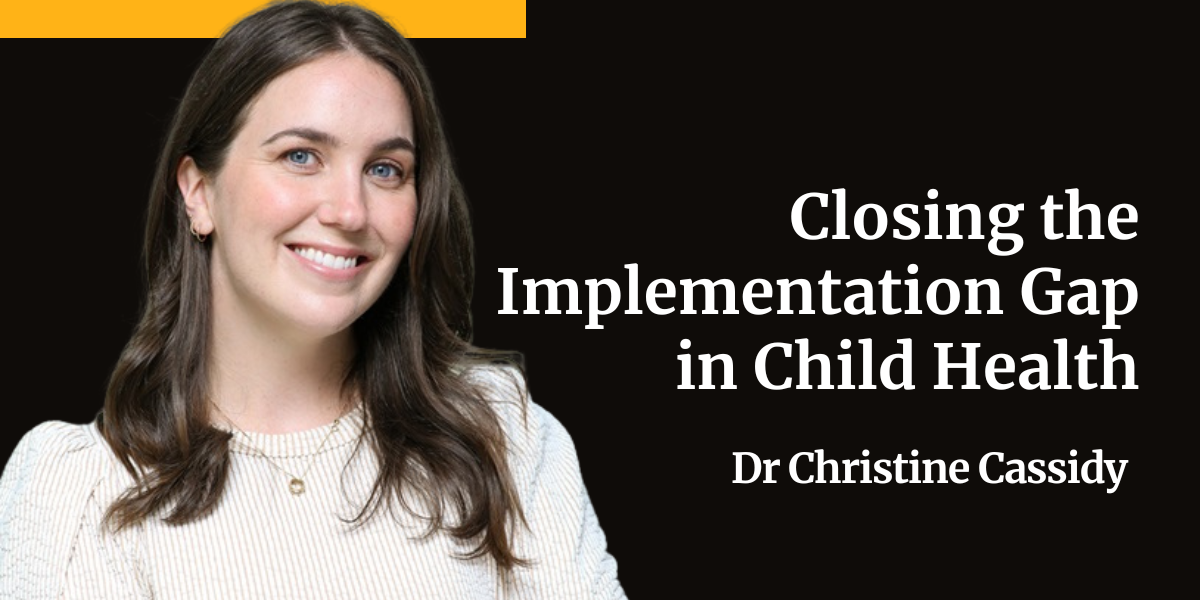
The inaugural UCC Futures Children seminar of the year brought together researchers, clinicians, academic and professional staff, and others interested in improving outcomes for children and families.
Opening the event, Professor Geraldine Boylan, Director of UCC Futures Children and INFANT Research Centre, highlighted the importance of creating stronger connections across disciplines at University College Cork (UCC), recognising that children’s outcomes are shaped not only by healthcare, but by education, family supports, environment and wider social systems.
Reflecting on the importance of implementation and impact, Professor Boylan noted:
“If we can’t implement research into practice, policy, systems or technology, what was the point of doing it in the first place?”
The keynote lecture was delivered by Dr Christine Cassidy, Associate Professor at Dalhousie University and Clinician Scientist specialising in child health at IWK Health. Introduced by Dr Rachel Flynn, School of Nursing, UCC, Dr Cassidy explored why implementation science and knowledge translation are essential to ensuring research delivers real-world change.
A central theme of the talk was the persistent gap between research and practice. Cassidy highlighted that despite the volume of healthcare research produced globally, evidence does not always translate into practice or policy, while some care delivered may still be low-value or even harmful.
Dr Cassidy emphasised that implementation should not be considered an afterthought once research is complete.
“We need to design research with implementation and impact in mind from the very beginning.”
Throughout the seminar, Dr Cassidy highlighted the importance of research co-production approaches that involve researchers, clinicians, patients, families and communities throughout the research process to ensure findings are relevant, usable and sustainable in real-world settings.
Drawing on examples from her work at the IWK Health Centre, Dr Cassidy demonstrated how collaborative implementation approaches can successfully bridge the gap between evidence and practice, particularly in improving transitions from paediatric to adult healthcare services.
Key themes that emerged from the talk included:
- Embedding implementation and impact planning into research from the outset
- Building stronger partnerships between researchers, clinicians, patients and families
- Developing implementation science capacity within health systems
- Creating “learning health systems” that continuously connect data, research and care
- Ensuring equity and sustainability are integrated throughout implementation processes
Dr Cassidy also shared practical examples from her own implementation science research throughout the seminar, illustrating how evidence can be successfully translated into practice. Her presentation, including links to related publications and projects, has kindly been shared here: UCC Futures Children – Christine Cassidy Presentation 2026
The seminar reinforced the vision behind UCC Futures Children: bringing together expertise across disciplines to support research that not only advances knowledge, but creates measurable improvements in children’s lives.