The gender gap in autism: why we need to do better for girls
Autism diagnosis can be a long and complex process. For some children, assessment takes years. Girls in particular are often identified much later than boys, sometimes not until adolescence meaning they can miss years of support when it matters most.
At the INFANT Research Centre in University College Cork, Dr Jane English is investigating whether biological signals present at birth could help change that timeline.
Her research focuses on identifying early-life biomarkers that may one day support earlier identification of autism, particularly those who could benefit from additional monitoring and support.
The aim is not to diagnose autism at birth, but to build the scientific foundation for earlier screening. If successful, this work could help reduce delays in identification and ensure more children, especially girls, receive support earlier in life.
“The overarching goal is to facilitate early intervention in children with autism.” English explains. “At the moment, diagnosis is complex, and quite often children are not diagnosed until the ages of four or five, and in some cases, much later”.
A system under pressure
In Ireland, autism diagnosis typically involves a multidisciplinary team assessment. While comprehensive, the system is under significant strain.
“There are thousands of families on waiting lists for a first-time autism assessment, with waiting times exceeding two years,” English says. “It is extremely challenging for families.”
Early intervention services such as speech and language therapy, occupational therapy and structured parent support can significantly improve a child’s development and quality of life.
However, timing is only part of the challenge. Gender also plays a role in when and how autism is recognised.
Why girls with autism are often missed
“We tend to catch boys earlier than girls,” English says. “The diagnostic criteria were largely designed around male-dominated profiles, and some females with autism do not fit this pattern.”
While boys may show more outward behaviours that are easier to recognise, girls are more likely to internalise their difficulties. They may appear shy or anxious while masking social discomfort and sensory challenges. As a result, their needs often go unnoticed, or they are misdiagnosed with anxiety or depression.
Recent research suggest that Autism is just as common in girls as in boys, yet boys are up to four times more likely to be diagnosed in childhood.
“The girls are there, but the system is just failing to see them” says English. “Delaying a diagnosis does not mean she is ‘fine’. It means she misses crucial support.”
This gap also affects research. Studies have historically focused more on males, limiting understanding of how autism presents biologically in females. Expanding female-focused research is therefore central to improving identification and support.
Investigating early-life biology
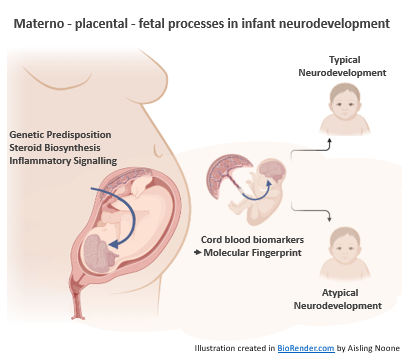
We know autism begins in the womb. That is why Dr English’s research focuses on the prenatal environment and the interaction between mother, placenta, and fetus.
Her team studies maternal cord blood collected immediately after delivery to identify molecular patterns linked to later autism diagnosis.
“We are looking for a molecular signature, like a fingerprint, in cord blood at birth,” explains Aisling Noone, a final year PhD student in the Department of Anatomy & Neuroscience.
Using large bio-banked pregnancy cohorts, researchers compare samples from children who later received an autism diagnosis and compare them with neurotypical children. This allows them to identify biological pathways associated with neurodevelopment.
This work is still in the discovery and validation phase.
“This type of research takes time,” English says. “The priority is to understand the biology properly and to replicate findings across populations.”
The team is particularly interested in inflammation and steroid biology during pregnancy. These factors alone cannot predict autism, but alongside genetic susceptibility they may offer important clues about how early development shapes later outcomes.
Understanding complexity
Autism is influenced by a complex interplay of genetic, biological and environmental factors. Rather than focusing on single markers, English’s team integrates multiple layers of information to help predict outcome.
This includes biomarker data alongside maternal clinical information such as mental health, stress, pregnancy complications, infection, and infant birth weight. Machine learning models are then used to explore how these factors interact.
“Instead of stripping away complexity, we incorporate it,” she says. “If something is going to be useful in practice, it has to work in the real world.”
This approach represents a shift towards understanding networks of risk and resilience, rather than searching for a single defining cause.
From discovery to responsible translation
The long-term ambition is not to provide a definitive diagnosis at birth. English is careful to draw that distinction.
“If the evidence supports it, this could one day contribute to a voluntary approach that helps families understand their child’s needs earlier.” English says.
In principle, such a system might resemble existing newborn screening frameworks, where parents opt in and receive information that supports monitoring and follow-up. Any future screening pathway would require extensive validation, ethical evaluation and close collaboration with clinicians and families.
For now, the work remains focused on strengthening the scientific evidence.
Looking ahead
Translating biomarker research into screening tools will take time, larger datasets, and continued collaboration across research and clinical communities. Expanding female-focused studies will also be essential so future approaches reflect the full diversity of how autism presents.
Much remains to be understood about how early biological signals relate to later neurodevelopment. But by investigating the earliest stages of life, this research is helping to build a stronger foundation for earlier identification.
Over time, these advances could help ensure that fewer children wait years for answers, and that girls who are currently overlooked are recognised earlier and supported sooner.
Acknowledgements:
This research was supported by the Irish Health Research Board (HRB) through an award to Dr Jane English.
For those interested in following this research or supporting future work in this area, please contact Merrin Browne, Research Engagement and Partnerships Manager, at merrinbrowne@ucc.ie or help support future research here.