INFANT PI leads National Bereavement Standards in Maternity Services

By |2022-02-08T10:31:34+00:00March 6th, 2019|

Pregnancy loss, in the form of early or late miscarriage, or stillbirth, neonatal or infant death, occurs in 20-25% of pregnancies and is the most common complication of pregnancy.

Dealing with the loss of a baby or pregnancy is a very difficult time for parents and families and providing bereavement care is an integral part of any maternity service.

Led by INFANT PI Dr Keelin O’Donoghue and with significant input from the INFANT/CUMH Pregnancy Loss Research Group, the accumulation of two year’s work on the HSE National Standards for Bereavement Care Following Pregnancy Loss and Perinatal Death was presented to 130 attendees at the Bereavement Forum at University College Cork last Saturday.
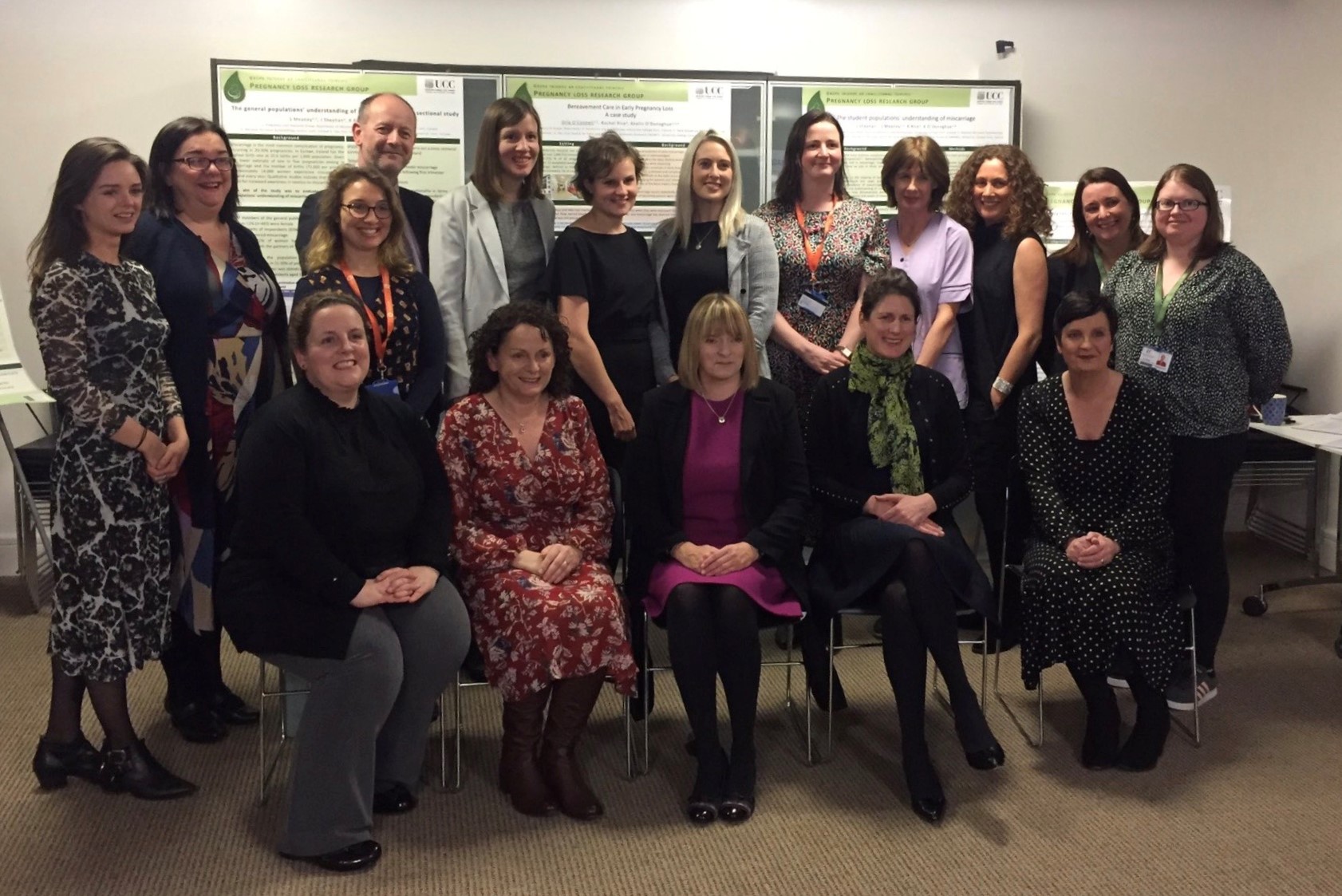
 

Members of the Pregnancy Loss Research Group, comprising staff from INFANT, UCC College of Medicine and Health and the National Perinatal Epidemiology Centre

Members of the Pregnancy Loss Research Group, comprising staff from INFANT, UCC College of Medicine and Health and the National Perinatal Epidemiology Centre

Dr Keelin O Donoghue, INFANT PI and Consultant Obstetrician & Gynaecologist, CUMH pictured with HSE programme manager Riona Cotter.

The HSE National Standards for Bereavement Care Following Pregnancy Loss and Perinatal Death was implemented to enhance bereavement care services for parents who experience a pregnancy loss or perinatal death. Used as a resource for both parents and professionals – it provides the template for maternity units to develop a compassionate, caring service for parents who lose a baby due to miscarriage, stillbirth and neonatal death.

Speaking on behalf of the National Implementation Group, Dr Keelin O’Donoghue said: “As we reach the end of the second year of the Implementation Programme we are delighted to see that progress has been made in the implementation of the Bereavement Standards nationally. We are grateful to all who have been involved in our programme of work. Putting these Standards into practice demonstrates our commitment to compassionate and high-quality care for parents while raising awareness of pregnancy loss and recognising its wide impact. We hope that this important work, which we know enhances care for bereaved parents and families, will now continue in all the 19 Maternity units, overseen by the Health Service Executive’s National Women and Infants Health Programme.”


Throughout the day, doctors, midwives, researchers, parent and patient groups shared their insights and learnings from the two-year implementation programme. It was of particular importance to the National Implementation Group that the National Bereavement Standards be informed and influenced by parents who have experienced pregnancy loss, and parent representatives have been key to its success.

Keelin and HSE programme manager, Midwife Riona Cotter travelled all over Ireland, visiting all 19 maternity hospitals where there is now a dedicated bereavement team in place implementing these standards.


The Pregnancy Loss Research Group at CUMH includes INFANT PhD students, Indra San Lazaro Campillo, Stacey Power, Aenne Helps and Tamara Escanuela Sanchez, INFANT research midwife AnnaMaria Verling, NPEC staff researcher Dr Sarah Meaney, UCC Lecturers Dr Margaret Murphy and Dr Daniel Nuzum, alongside MSc, medical students and other clinicians. Working collaboratively with the common goal – to provide support and information to parents bereaved by early and late pregnancy loss, promote their emotional, psychological, spiritual and physical well-being, as well as improving professional practice and facilitating research in this area.

Copies of the HSE National Standards for Bereavement Care following Pregnancy Loss and Perinatal Death are available to download online.

INFANT celebrates Engineers Week 2019

By |2020-11-22T12:43:01+00:00March 4th, 2019|

Monday 04 March 2019

The INFANT centre is made up of world-leading researchers from a variety of disciplines. Our engineers are involved in various research projects and their highly acclaimed work has been widely recognised.

Our engineers are working collaboratively with a number of academic and industry partners from all over the world to improve the health of mothers and babies and to prevent poor outcomes.

We asked them to tell us a little about the projects they are working on and what excites them about their role.


INFANT takes to the stage at FameLab Cork

By |2020-11-22T12:43:16+00:00March 1st, 2019|

Friday 01 March 2019

Held annually in over 30 countries across the globe, FameLab is the world’s largest science communication competition.

The Cork event took place at Triskel Arts Centre on Wednesday night.

Armed only with their wits and a few props, the newest voices from the world of science and engineering across the county delivered short 3-minute presentations on a range of science topics.

Representing INFANT, PhD student Sam Manna presented a fun and engaging talk on ‘Anti-Ageing 101’.

Well done Sam and to everyone involved.

INFANT strengthens Tanzanian partnership

By |2020-11-22T12:43:38+00:00February 28th, 2019|

Thursday 28 February 2019

A team from INFANT travel to Kilimanjaro Clinical Research Institute in Moshi, Northern Tanzania this week.

As Ireland’s first and only perinatal research centre, INFANT is focussed on making pregnancy safer and improving health outcomes for mothers and babies worldwide. In particular, the centre’s Global Health Program is committed to translating the centre’s innovations into affordable, accessible interventions in countries where the clinical need is greatest and will have the highest impact.

In 2016, INFANT signed a Memorandum of Understanding with the Kilimanjaro Clinical Research Institute (KCRI), the Kilimanjaro Christian Medical Centre (KCMC), and the Kilimanjaro Christian Medical University College (KCMUC) establishing a collaborative research partnership in a number of scientific and clinical areas.

Mike Cuneen, INFANT Software Developer presenting the new cloud-based birth registry to KCMC clinicians.

This partnership is currently working on a project to enhance the KCMC birth registry. Birth registry data is a vital source of information for healthcare providers, funders and policy makers as it contains data on maternal and infant outcomes from each baby born every year. INFANT engineers and software developers initiated and developed this project to enhance the KCMC Medical Birth Registry, making this hugely valuable data accessible to researchers beyond KCMC and INFANT.  This week INFANT will pilot the new high quality, cloud-based birth registry, provide essential training to staff and implement improvements to the system based on local feedback at KCMC.

KCMC staff undertaking bubble CPAP training.

The week-long visit will also include a number of meetings with research and clinical colleagues, tours of the Maternity Ward and Birth Registry Offices, a visit to a regional community health centre, discussions on collaborative funding opportunities and the initiation of a postgraduate student exchange programme.

Speaking about the trip, INFANT Director Prof Geraldine Boylan said that the collaboration between INFANT, UCC and KCRI has gone from strength to strength and she acknowledged the important role that support from ESTHER Ireland had played in enhancing this important collaboration.

Professor Helen Whelton, Head of College of Medicine and Health commented “The partnership to date has been a huge success and we look forward to strengthening our relationship with KCMC in the coming years. International engagement is a priority for UCC and partnerships like these enhance our mission of creating, understanding and sharing knowledge and applying it for the good of all”.

INFANT researchers join leading academics to discuss the future of machine learning

By |2020-11-22T12:43:53+00:00February 19th, 2019|

Tuesday 19 February 2019

This week, INFANT Director and Associate Investigators presented at ‘The Future of Machine Learning’ Conference at the Maryborough Hotel, Cork.

The event organised by MIDAS, in conjunction with Qualcomm and UCC brought together experts in the field of artificial intelligence and machine learning to encourage collaboration and innovation that leverages machine learning in Ireland. The day included discussions on why machine learning is important to Ireland and how Ireland’s machine learning research and development is establishing and pushing the research vision.

Prof Geraldine Boylan presented ‘Big ideas for little brains – using AI to help identify brain injury in newborn infants‘. Using artificial intelligence, INFANT has developed the world’s first AI algorithm that can detect seizures in newborns and the centre is continuously looking at ways to integrate AI into its healthcare research.

INFANT has a large portfolio of projects for AI in healthcare research and last year won the AI Ireland National Award for ‘Best Appilication of AI in an Acaedemic Research Body’.

Speaking after the event Prof Boylan said, “I was delighted to present at this high calibre event and for the opportunity to network with colleagues in academia, industry and Government. We are really at the start of a revolution in the use of AI for health care that will shape the Neonatal Intensive Care Unit of the future. Partnering with AI and machine learning experts throughout Ireland will allow INFANT to further develop innovative technologies in healthcare and to make it a reality for all”.

INFANT and UCC was well represented on the day with INFANT Associate Investigators Dr Andriy Temko and Dr Emanuel Popovici also presenting at the event.

TIDA Award to impact INFANT research commercialisation

By |2020-11-22T12:44:15+00:00February 4th, 2019|

Monday 04 February 2019

Minister for Business, Enterprise and Innovation, Heather Humphreys TD, and Minister for Training, Skills, Innovation, Research and Development, John Halligan TD, today announced €4.5 million in funding for 38 research projects to support the commercialisation of government-funded research.

The funding is provided through Science Foundation Ireland’s Technology Innovation Development Award (TIDA) programme, which has been running since 2009. The programme provides project development funding and training in entrepreneurship skills to third-level researchers, to support them in exploring commercial opportunities associated with their research.

John was awarded €124,712 which he will use to support the development of a computer-based system that continuously monitors the brain health of preterm infants in intensive care. Worldwide, over 2 million infants born prematurely are at an increased risk (1 in 3) of brain injury. This injury can be fatal or can result in a lifetime of disability. Knowing which infants are at risk ensures that that the right infants get the right medical care at the right time. John and his research group will pursue commercial pathways to transition this technology from academia to industry in order to safeguard the brains of this vulnerable population.

Pictured: Dr John O Toole

Researchers funded through the TIDA programme will also participate in the new SFI Spark Pre-Accelerator, which is an intensive five-day programme delivered by the DCU Ryan Academy for Entrepreneurs. This will support STEM researchers to develop skills in areas such as evidence-based entrepreneurship, innovation and design thinking and facilitates mentoring and networking.

Prof Geraldine Boylan, Director of INFANT, said “I offer my congratulations to John – INFANT is delighted to support this worthy research project. Awards like the TIDA programme allow us to continue to create ground-breaking discoveries and translate them into innovative tests, treatments and solutions that will positively impact mothers, newborn and children’s health outcomes internationally”.

CREATE comes to Cork

By |2020-11-22T12:44:31+00:00January 18th, 2019|

Friday 18 January 2019

CREATE was launched last night at St. Peters Gallery.

The pregnancy and neonatal journey can be beautiful and scary, joyous and heartbreaking. It can be miraculous, frustrating, sought after or unexpected. It can be straightforward, or it can wind and twist through our lives. We think of it as nine months, but it can be years of trying. It can end unexpectedly. It can resonate for decades afterwards.

Every single pregnancy and neonatal journey is unique.

In this exhibition, the HRB Mother and Baby Clinical Trial Network, a network of obstetricians, neonatologists, midwives and related health professionals brought together to carry out research on women’s and children’s health, hope to highlight common pregnancy and newborn health issues and celebrate the impact of perinatal research on mothers and babies in Ireland and internationally.

The network which brings experts from seven of the largest maternity hospitals in Ireland together are focusing on improving the health and lives of mothers and babies in Ireland and around the world. INFANT co-leads the network.

Featured artist Yonit Kosovske

Speaking at the launch of the CREATE Exhibition, Prof Geraldine Boylan INFANT Director said, “INFANT is delighted that we have the opportunity to host CREATE in Cork and to showcase the exhibition to our local community. It is wonderful to see scientists and artists working together, to share knowledge and to create new ways of seeing and communicating research. INFANT is proud to be part of the HRB Mothers and Babies Clinical Trial Network as our centre echoes the commitment of the network to put women and children at the heart of our research.”

The exhibition will run until the 27th January, and local breastfeeding groups in particular are invited to meet in the Gallery and explore the exhibition.

The full list of artworks and events is available at http://www.hrb-mbctni.ie/create/ ​

CREATE banner

INFANT researchers successful in securing SIRG Awards

By |2020-11-22T12:44:58+00:00January 16th, 2019|

Wednesday 16 January 2019

At a launch event yesterday in Dublin, SFI revealed twenty projects are set to be funded by their Starting Investigator Research Grant (SIRG) in 2019. The prestigious grant for early career researchers supports postdoctoral scientists as they develop the necessary skills and experience required for a fully independent research career.

Two INFANT and UCC researchers were worthy recipients in the areas of maternal and infant nutrition and novel therapies for premature babies.

INFANT researcher Dr Aine Hennessy was awarded €424,898 over four years to develop her project “An exploration of the suitability of thyroid hormones in measuring iodine deficiency during pregnancy and its impact on infant brain development”.

The nutrient iodine plays a central role in the production of thyroid hormones. During pregnancy, iodine deficiency can result in severe and long-lasting consequences for an infant’s developing brain. In Ireland, three-quarters of women have inadequate iodine intake. However, the magnitude of this impact on the brain development of Irish infants is unknown. As there is no reliable measure of individual iodine status, this proposal will test the suitability of thyroid hormones to be used as a proxy measure. The data from previous studies will be used to describe the impact of maternal iodine deficiency on the neurodevelopment of infants.

This funding will allow Aine to continue her research at INFANT, supervise a postgraduate student associated with the project and provide an opportunity for her to work with her mentor, INFANT Principal Investigator Prof Mairead Kiely.

Pictured: Prof Mark Ferguson SFI Director, Dr Fiona McDonald and Minister Pat Breen TD.

INFANT associate Dr Fiona McDonald was awarded a total of €424,913 for the duration of her four year project “A study on the health of premature babies, exploring the development of therapies using a novel protective dietary antioxidant intervention”.

Immature development of breathing in preterm babies and the necessary interventional treatment in the intensive care unit results in improper unstable oxygen status, which can impact on health even into adulthood. Late onset hospital acquired infection in preterm babies is an urgent unmet clinical need with up to 20% fatality. The combined effects of impaired oxygen status due to immaturity and acquired infection on physiological health will be examined throughout the project. Consequently, a novel protective dietary antioxidant intervention will be explored with a view to the development of therapies for preterm babies into the future.

As a result of the SIRG award, Fiona will now be working collaboratively with the team at INFANT under the guidance of her mentors, INFANT Principal Investigator Prof Eugene Dempsey and UCC INFANT associated investigator and Chair of Physiology, Prof Ken O’ Halloran.

Prof Geraldine Boylan, Director of INFANT commented “The SIRG awards are highly competitive and sought after awards for the next wave of early career post-doctoral researchers. We offer warm congratulations to Aine and Fiona in their success in winning these awards. INFANT are delighted to be partners in supporting this research and these projects. They are both addressing key questions of maternal and early infant health. UCC should be very proud of this emerging talent and we look forward to developing their research and research careers within the INFANT community”.

Congratulation to both Aine and Fiona, we look forward to the impact your research will have in the coming years.

INFANT research identifies biomarkers to detect brain injury in newborns

By |2020-11-22T12:45:17+00:00January 7th, 2019|

Monday 07 January 2019

Lack of oxygen to the brain at birth affects almost 200 babies in Ireland each year and results in death  or disability in over 2 million infants each year globally. The condition, known as Hypoxic Ischaematic Encephalopathy (HIE), causes brain injury due to lack of oxygen and can leave newborns with permanent neurological damage or cerebral palsy. HIE can be difficult to detect in newborns; early intervention and treatment is vital to improving outcomes and and reducing the impact and severity of the brain damage.

Researchers at Ireland’s dedicated fetal and neonatal research centre, INFANT Centre, along with collaborators at UCC and the Karolinksa Institute in Sweden have identified two biochemical signals that can be used to aid the detection of birth-related brain injury. These blood biomarkers found in the umbilical cord could provide an early detection system for HIE in newborns. Early intervention in neonatal brain injury is critical so that the successful brain cooling therapy can be initiated immediately to reduce brain injury and improve outcomes.

The findings published this week in the Journal of the American Medical Association (JAMA) Neurology, validated the involvement of two microRNAs in HIE. microRNAS are small strands of genetic code that can control gene expression and protein production in the cell. They are found throughout the body, and INFANT researchers have found them to be abundant in umbilical cord blood, and significantly decreased in newborns with HIE. They may provide the first clue that significant injury has occurred and help doctors to decide which infants to transfer to a cooling centre for treatment.

Consultant Paediatrician, Principal Investigator at INFANT and UCC Professor Deirdre Murray has led this breakthrough research in the area of HIE and perinatal asphyxia, published in the JAMA recently (28 December 2018).

Consultant Paediatrician and Principal Investigator at INFANT Professor Deirdre Murray.

“The results from this initial study are very promising. In two different cohorts, across two countries we are seeing the same patterns. The next task will be automating this analysis so that it can be done rapidly at the cotside. We are still researching these microRNA to understand if the have an important role in the cascade of injury which occurs in HIE. They are tiny nuclear codes which act like passwords to control the production of proteins in the cell. Some of these proteins may have important roles. We have now been funded by the Irish Research Council to examine whether manipulating these microRNA could reduce or prevent brain injury. This is still a lot of work to be done and we look forward to progressing this important research.” said Principal Investigator at INFANT and UCC Professor Deirdre Murray.

The study was supported by funding from the Health Research Board and the National Children’s Research Centre and is the result of almost 10 years of study in the area of early brain injury.

INFANT Director, Prof. Geraldine Boylan commented “This is a very significant breakthrough in brain injury research and INFANT is delighted that the results of this work are being recognised in such a high impact journal. This is fantastic validation of the excellent work being done at INFANT and our clinical colleagues in Cork University Maternity Hospital. We are very grateful for the funding support from the NCRC and HRB and we will be focussed on developing this as an effective point-of-care test”.

Neonatal hypoxic-ischemic encephalopathy (HIE) remains a significant cuase of neurologic disability all over the world. Identifying infants suitable for therapeutic hypothermia (brain cooling) within a narrow therapeutic time is difficult and up to now, there has been no single robust biochemical marker available to clinicians. This research has been able to identify the microRNA in the umbilical cord and this is a very important step in the early diagnosis and treatment of babies affected by lack of oxygen to the brain.

Babies in Ireland have participated in the research study, which saw umbilical cord blood samples from 170 newborn babies from Ireland and Sweden being collected and analyised over a number of years.

INFANT research named in Wellcome Trust Top 10

By |2020-11-22T12:45:48+00:00December 21st, 2018|

Friday 21 December 2018

AI is helping babies at risk of brain injury

Time is critical for doctors treating newborn babies with suspected brain injuries. The sooner treatments such as whole body cooling can be used, the better the outcomes are likely to be.

Doctors rely on the results of EEG brain monitoring to give them crucial information. But these brain scans are so detailed they can only be interpreted by an expert, and there aren’t enough experts for someone to be at every cot side.

Wellcome-funded researchers at the INFANT Centre at University College Cork are developing the first ‘smart’ system to recognise patterns in electrical brain activity, which will help to identify babies who need treatment quickly.

Read the full article here: https://wellcome.ac.uk/news/10-ways-remarkable-research-protecting-health

For privacy reasons YouTube needs your permission to be loaded.
Go to Top