
PhD Profile: Shuwen Yu Describes How Automation Can Help Predict Seizures in the Neonatal Brain

By |2021-12-02T14:56:29+00:00December 6th, 2021|

A graduate of the MEngSc in Electrical and Electronic Engineering at University College Cork, Shuwen Yu joins the INFANT Research Centre to begin working on a PhD programme under the supervision of Professor Geraldine Boylan, Professor Liam Marnane and Dr Gordon Lightbody.

A stellar student at the North China Institute of Aerospace Engineering, where Shuwen received numerous awards and scholarships, including the China Space Foundation Scholarship, a National Scholarship of China and a China Aerospace Science and Technology Corporation Scholarship on his way to graduating with a Bachelor of Engineering in 2019.

One year later, Shuwen came to study at UCC, where he developed advanced skills in the field of automation and honed his knowledge of robotics.

In 2020 I came to Cork to study under Professor Liam Marnane and Dr Gordon Lightbody.

It was at UCC where I really learned a lot about Python and started to think about doing a PhD.

When I learned about the opportunity to study machine learning under Professor Marnane and Dr Lightbody at INFANT, my mind was made up.

Shuwen enrolled in the PhD programme in October and has begun working on the project to develop machine learning tools for clinical support in the protection of the neonatal brain.

The four-year project is part of a wider and more ambitious endeavour being undertaken by Professor Marnane and Dr Lightbody, who, alongside Professor Geraldine Boylan, are aiming to develop AI models that will help the early detection of neurological complications in infants and provide systems to allow for the effective monitoring of the efficacy of therapeutic interventions.

Specifically, Shuwen will be examining dynamic modelling techniques to help with the development of machine learning tools for clinical support in the protection of the neonatal brain.

Having just started the PhD programme in October, Shuwen is in the process of surveying data that he hopes will eventually help him to design a system that will result in better clinical outcomes for pre-term babies.
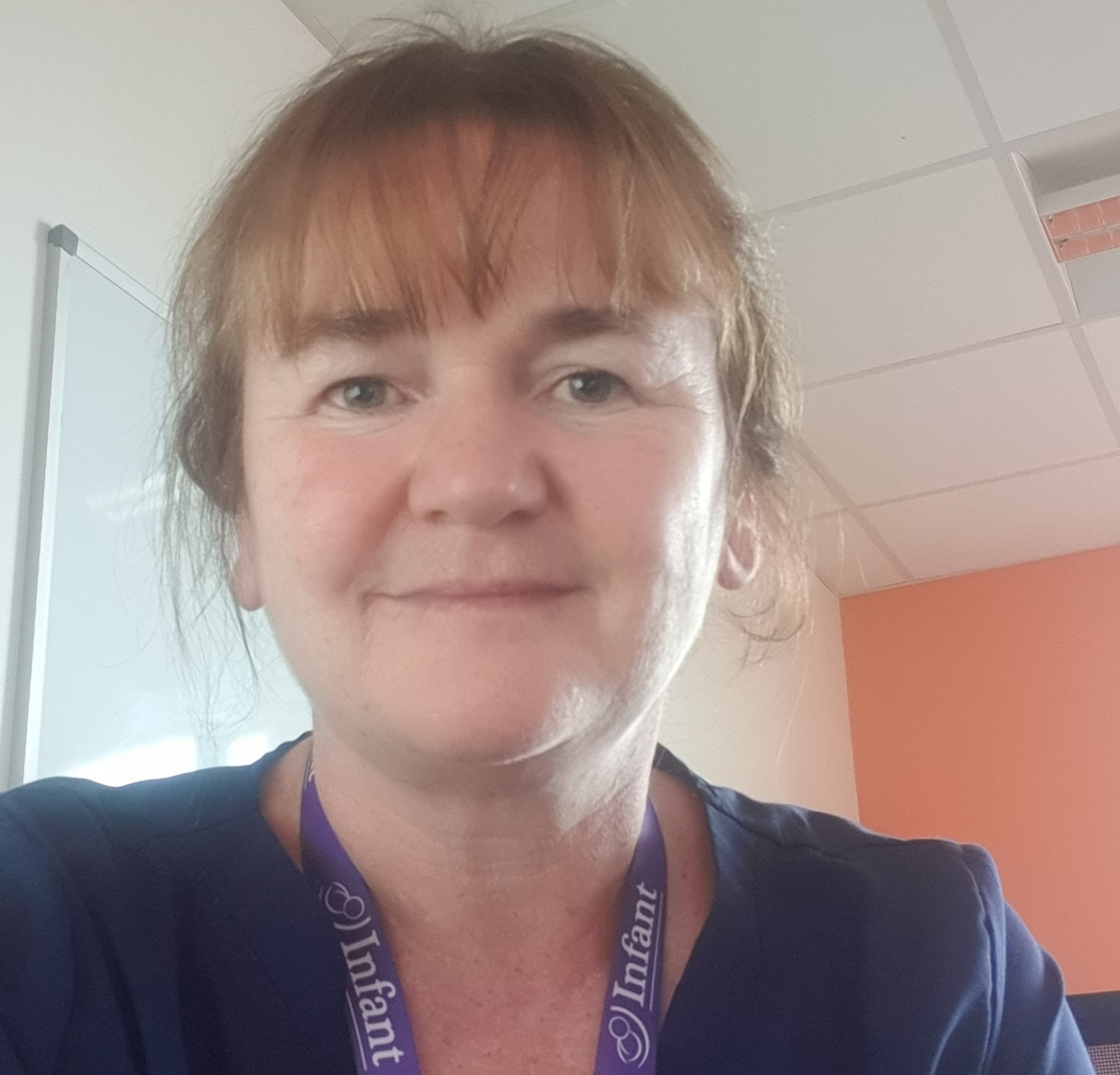
PhD Student Profile: Mary Anne Ryan, General Nurse, Paediatric Nurse and Mid-Wife

By |2021-10-14T10:52:28+01:00October 13th, 2021|

Introducing herself as a registered general nurse, paediatric nurse and a mid-wife, INFANT PhD researcher, Mary Anne Ryan, is fervent in her desire to protect brain development of pre-term babies who pass through the neonatal unit in CUMH.

Mary Anne describes how advances in technology have pushed back the limits of viability, reducing mortality associated with preterm birth. However there has been little change in morbidity amongst the preterm infant group.

A clinical researcher, Mary Anne has a specific interest in the importance of sleep to the developing brain, explaining that sleep is a prerequisite for normal growth and a precondition for the normal development of the infrastructure of the brain.

‘There is a reason why preterm babies may sleep for up to 90% of the day. Whilst it may appear to be physically passive and restful, a high level of brain activity is maintained, which is crucial to a preterm infants’ developing brain’.

‘While we monitor heart rate, respirations, temperature, how well the body is oxygenated and the nutritional intake of preterm infants in the neonatal unit, we do not routinely monitor brain activity’.

Brain activity may be monitored through electroencephalography (EEG). Sleep states (active sleep and quiet sleep) are associated with particular neural activity patterns which change with brain maturation.

‘Knowing what features and patterns are normal for gestational age we can determine if the brain development is on a normal trajectory of development’.

Mary Anne’s research focuses on moderate to late preterm infants (born between 32- and 36+6-weeks GA). A preterm group represent up to 85% of all preterm infants born and are largely underrepresented in the literature.

‘Normally, brain growth and development occur in the womb until term, a place of minimal sensory exposure’.

‘The high sensory environment of the neonatal unit may be home to preterm infants for many weeks with bright lights, high levels of noise, stressful painful procedures, all of which frequently interrupt sleep our natural neuroprotective state during a critical period of development’.

‘What I’m really asking is what does the sleep architecture of the moderate to late preterm infant at 36 weeks in the neonatal unit tell us about their future brain development?’

Mary Anne’s research required her to carry out overnight EEG’s on over 100 preterm infants at 36 weeks in the neonatal unit in CUMH and carry out follow up developmental assessments at four- and 18-months corrected age. Sleep/wake patterns during the preterm period have been found to be related to developmental outcomes. However longitudinal studies relating to sleep state organisation amongst this homogenous group of preterm infants are rare.

‘Secondly, I’m asking, how does brain development of this preterm infant group compare to healthy term born infants at the same gestational age?’

‘Traditionally healthy moderate to late preterm infants have minimal ongoing long-term surveillance’.

‘Whilst the majority of these infants do well a significantly higher percentage of adverse outcomes are evident in the literature in comparison to term born infants’.

Mary Anne’s research will also compare developmental outcome scores of the preterm infant group to a term born group recruited as part of another study.

Motivated by a desire to enhance the care that is already being delivered to pre-term babies, Mary Anne’s focus on the practical application of her research stems from her conviction that nurses bring a unique contribution to neurodevelopmental care.

As a clinical researcher, Mary Anne has a specific interest in the practical application of her research, which could lead to the adoption of new practices that create periods of protected sleep so as to improve the long-term neuro-developmental outcomes for pre-term babies.

Go to Top