INFANT researcher shares PremSmart success at international health innovation event in Brussels
INFANT researcher shares PremSmart success at international health innovation event in Brussels
INFANT’s newly formed Neonatal Clinical Nutrition Research Group was represented at a major international event exploring how healthcare innovation can improve outcomes for women and children worldwide.
INFANT’s Neonatal Clinical Nutrition Research Group (NCNRG) was invited to attend Investing in our Future: How Innovation Can Help Save Women and Children’s Lives in Brussels on 14 October, represented by Dr Ann-Marie Brennan and Sarah Fenton.
Held in association with the Gates Foundation and the Irish Presidency of the Council of the EU, the event brought together policymakers, global health leaders, funders and innovators to explore how healthcare innovations can be brought to scale.
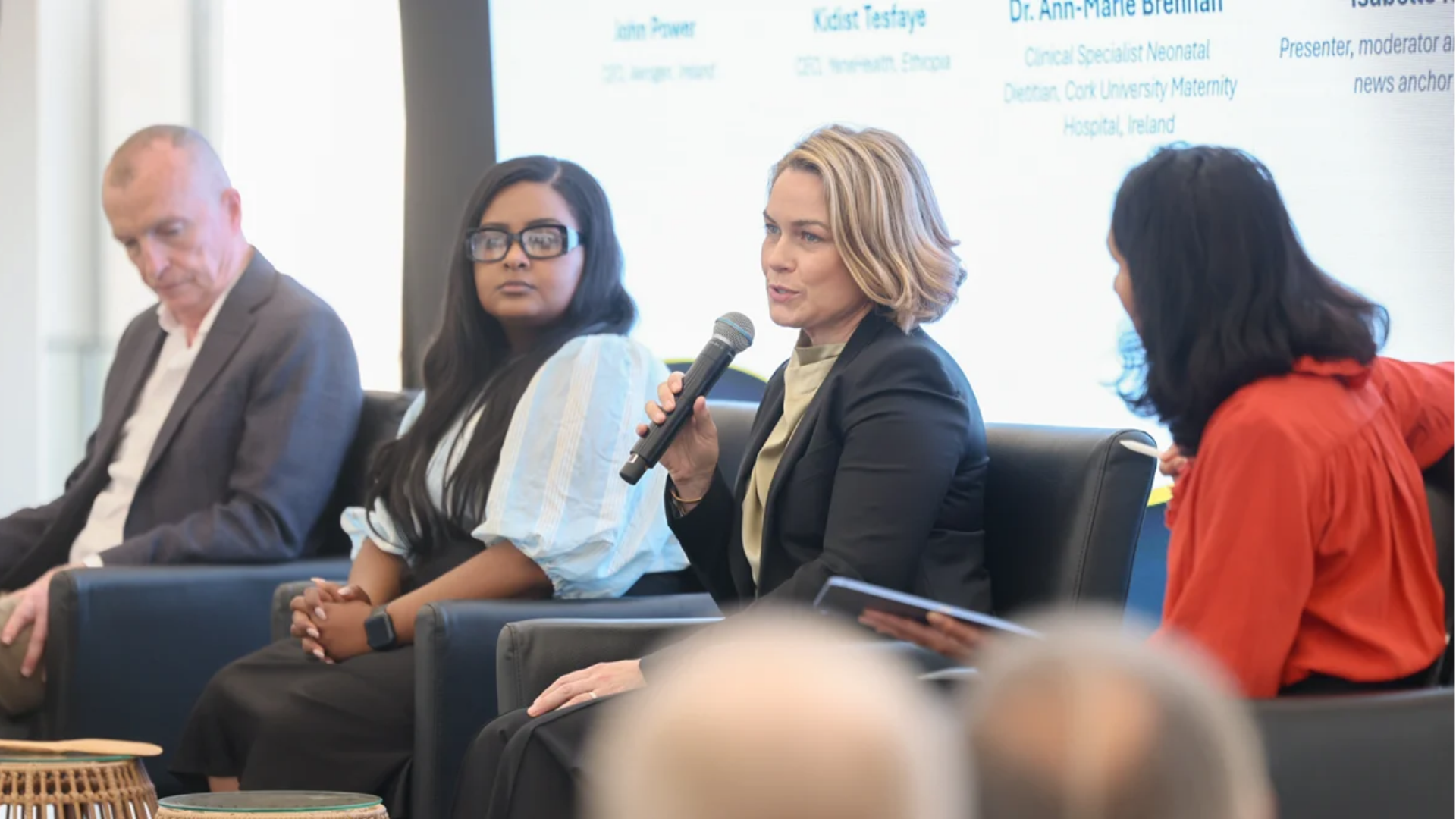
Dr Brennan was invited to join the event’s From Idea to Impact: Innovators’ Fireside Chat, alongside John Power, CEO and Founder of Aerogen, and Kidist Tesfaye, CEO and Founder of Yene Health, where she shared the successful national scale-up of PremSmart.
Dr Brennan is a Lead Investigator at INFANT Research Centre, Senior Lecturer in the School of Food and Nutritional Sciences at University College Cork (UCC), and Clinical Specialist Neonatal Dietitian at Cork University Maternity Hospital (CUMH).
From research to national implementation
PremSmart is a research-led initiative improving nutritional care for premature babies through a standardised approach to parenteral nutrition.
Developed through collaboration between INFANT, CUMH and the Irish health service, PremSmart has now been adopted across all nine neonatal units providing parenteral nutrition in Ireland, accounting for approximately 95% of neonatal parenteral nutrition nationally. It is also estimated to save the Irish health service approximately €1 million annually.
PremSmart’s successful national implementation generated particular interest in Brussels, where a key focus was how proven innovations can move beyond individual hospitals or pilot programmes to achieve wider and sustainable impact.
Dr Brennan said:
“It was really encouraging to see the level of interest in how PremSmart has moved from research into national implementation. We’ve learned a lot about what it takes to successfully implement change across a health system, and there is still work to do to ensure that progress is sustainable in Ireland.
“The next question is how we build on that experience – both by continuing to strengthen PremSmart here and by exploring how elements of the approach could be adapted for other healthcare settings, particularly in low- and middle-income countries.
“That can’t simply be about taking something that works in Ireland and applying it elsewhere. It has to be led by local needs and developed with the right clinical and research partners.”
Read more: Giving premature babies a stronger start: how PremSmart transformed neonatal nutrition in Ireland
Building on international partnerships
INFANT’s wider international work also formed part of the conversation, with Minister of State for International Development and Diaspora Neale Richmond TD referencing the INFANT-led Horizon Europe project LINDA-FAMILIA during his opening remarks.
Discussions around adapting innovation for different health systems also touched on INFANT’s existing partnerships and experience in East Africa.
The event provided an opportunity to share Ireland’s experience of taking PremSmart from research to national implementation, while contributing to wider discussions about how research, partnerships and investment can improve outcomes for women and children globally.
PremSmart forms part of the wider work of INFANT’s Neonatal Clinical Nutrition Research Group, which is expanding its research beyond parenteral nutrition to address broader questions in neonatal clinical nutrition.
Learn more: Neonatal Clinical Nutrition Research Group