Funded PhD Opportunity, supported by the HRB CRF (Clinical Research Facility) UCC

By |2023-07-10T15:59:06+01:00July 10th, 2023|

Funded PhD, supported by the HRB CRF (Clinical Research Facility) UCC

Project Title: PPI in clinical trials for vulnerable populations

This HRB CRF (Clinical Research Facility) UCC fully funded PhD involves a multistakeholder collaboration between CRFC, PPI Ignite Network @ UCC and the INFANT Research Centre.

The PhD will address conceptual and implementation aspects of PPI in the context of clinical trials in neonates/children. The work will be embedded within one or more ongoing CRF/UCC trials. The PhD will inform ongoing CRFC best practice implementation of PPI in clinical trials for diverse patient population groups, as well as develop the theoretical and PPI implementation competence of the successful PhD scholar.

Funding arrangement: Full time four years.

Supports: Placement in INFANT.

UCC PhD supports and training.

Supported by PPI Ignite Network @ UCC

Registration: Full time

Stipend: €19,000

The PhD will be supervised by Professor Geraldine Boylan, Professor Patricia Kearney, Site Lead PPI Ignite @ UCC and Dr Emmy Racine, Programme Manager, PPI Ignite @ UCC.

To apply please send a statement of interest (<200 words) and a brief (2 page max) CV to Professor Patricia Kearney, PPI Ignite @ UCC. Email: patricia.kearney@ucc.ie

CLOSING DATE: Thursday July 27th

INFANT PhD Profile: Dr Emily O’Connor’s Work to Standardise The Way Reviews of Perinatal Deaths Occur

By |2022-02-09T14:42:18+00:00February 9th, 2022|

Dr Emily O’Connor is pursuing a PhD in the area of perinatal medicine with INFANT and NPEC at UCC. Her background includes previous work as a Specialist Registrar in obstetrics and gynaecology with the Royal College of Physicians in Ireland (RCPI).  

Emily is extremely passionate about improving our maternity and perinatal services as well as improving the experience of parents who use those services.  

Emily’s planned thesis is titled: Structured Evaluation and Implementation of a National Perinatal Mortality Review Tool for Ireland.  Her research is funded by Féileacáin, the Stillbirth and Neonatal Death Association of Ireland.  

Perinatal deaths encompass babies who die before they are born (stillbirth), during labour or delivery (intrapartum death) or after birth (neonatal death). The Irish perinatal mortality rate has remained stable over the last ten years but has not decreased over this period.  

Emily’s work aims to standardise the way reviews of perinatal deaths occur by developing and implementing a national perinatal mortality audit tool for all perinatal deaths occurring in every maternity unit across Ireland.   

A major focus of this work is the involvement of bereaved parents in the review process. The aim of this research is to offer a more inclusive, transparent process for parents who have experienced the loss of their baby.  

Emily is conducting this research with the Pregnancy Loss Research Group based at INFANT and the NPEC. Her supervisors are Professor Keelin O’Donoghue (INFANT), Professor Richard Greene (NPEC) and Dr Sara Leitao (NPEC).  


PhD Profile: Cathal Dorgan’s Fascinating Project That Connects Maths and Neuroscience

By |2021-12-16T15:15:08+00:00December 16th, 2021|

An emerging expert in the field of non-linear dynamics, Cathal Dorgan joined INFANT as a PhD researcher in October, bringing with him cutting edge knowledge and ideas.

An ambitious researcher, Cathal aspired to enrol in a postgraduate programme that offered him the opportunity to delve deeper into areas that specifically interested him after completing a Bachelor of Science at University College Cork.

As part of my final year project, I focussed on nonlinear dynamics. It was a field that I became increasingly interested in as I progressed through my undergraduate degree.

So, when I saw how nonlinear dynamics were at the core of the project INFANT were recruiting PhD students for, I jumped at the chance to apply for it.

Thankfully, I was successful in my application and received the opportunity to begin working at INFANT in October.

Studying under the supervision of Professor Sebastian Wieczorek, Cathal will be working on an SFI Frontiers for the Future project that is developing decision support tools for newborn brain protection at INFANT.

Specifically, Cathal will be applying mathematical techniques, models and theories so that the project team can accurately depict the behaviour of the neonatal brain.

Using various mathematical techniques like tipping point theory, transitions and bifurcation theory, we hope to model instabilities in the neonatal brain.

At the moment, I’m learning more about the mathematical theories that we’re planning to employ and the neurosciences that are at the heart of the project.

Ultimately, we want to identify abnormalities so that we can create a system that can predict seizures.

Curious by nature, Cathal is embracing the challenge of learning about neurosciences and breaking into an unfamiliar discipline.

Helped by the team of researchers that Professor Liam Marnane and Dr Gordon Lightbody have assembled to undertake the project, Cathal is already picking up on the nuances and intricacies associated with neurosciences.

Even though I’m only two months into the project, I’m already seeing how neuroscience and maths can interact and overlap.

There are five PhD students working on the project and we’re all working toward a solution from different angles. It’s hugely collaborative and really fascinating.

The multidisciplinary insights that Cathal is already gaining from the project are broadening his horizons and inspiring him to look at the possibility of working in a career that straddles industry and academia after he graduates.

PhD Profile: Georgios Papanikolaou Explains How He’s leveraging Mathematical Systems to Identify Seizures in Infants

By |2021-12-09T16:10:59+00:00December 9th, 2021|

A PhD researcher with an eye for identifying the synergies that connect industry and academia, Georgios Papanikolaou comes to INFANT to work on an SFI Frontiers for the Future project to develop new AI models to predict seizures in the neonatal brain.

Working under the supervision of Professor Geraldine Boylan, Professor Liam Marnane and Professor Sebastian Wieczorek, Georgios is looking to combine mathematical systems, such as machine learning, system and control theory and tipping point theory, with real seizure data to develop models to foresee and identify the onset of seizures and develop strategies to reduce them in premature babies.

We already have programmes that can detect seizures, but what we want to do is to build a model that can predict them.

We want to identify specific readings from EEG and ECG signals so that we’re able to recognise the hallmarks of a seizure so that we can create an algorithm that can accurately identify and predict them.

Our first step is to precisely map a seizure and create a model that can identify one, then we’ll start working backwards to try and identify key indicators.

If we can do that, then we can start building a machine learning model.

Georgios will lean on his experience of applying mathematical theory across diverse industries during the project.

After graduating from Aristotle University of Thessaloniki with an MSc in Theoretical Computer Science and System and Control Theory, Georgios worked as a researcher with United Technologies Research Centre in Cork.

There, he worked on a project linked to the aerospace industry, focussing primarily on requirement formalisation so that data from key processes could be tested and maintained.

The programme that Georgios and his colleagues developed earned them a publication titled “ReForm: A Tool for Rapid Requirements Formalization”.

I’m really interested in applying knowledge across multiple industries and disciplines.

That’s what really excited me about this project. I understood how the knowledge that I had developed at United Technologies Research Centre could be applied in INFANT.

You can see how mathematical theories can be applied across multiple fields. Watching these ideas flow from one industry to the next is fascinating and the results only add to our knowledge.

In this sense, Georgios will not just contribute knowledge to INFANT, he also brings a passion for developing tangible solutions to research problems, enabling him to overcome any problems or challenges that he may encounter.

PhD Profile: Shuwen Yu Describes How Automation Can Help Predict Seizures in the Neonatal Brain

By |2021-12-02T14:56:29+00:00December 6th, 2021|

A graduate of the MEngSc in Electrical and Electronic Engineering at University College Cork, Shuwen Yu joins the INFANT Research Centre to begin working on a PhD programme under the supervision of Professor Geraldine Boylan, Professor Liam Marnane and Dr Gordon Lightbody.

A stellar student at the North China Institute of Aerospace Engineering, where Shuwen received numerous awards and scholarships, including the China Space Foundation Scholarship, a National Scholarship of China and a China Aerospace Science and Technology Corporation Scholarship on his way to graduating with a Bachelor of Engineering in 2019.

One year later, Shuwen came to study at UCC, where he developed advanced skills in the field of automation and honed his knowledge of robotics.

In 2020 I came to Cork to study under Professor Liam Marnane and Dr Gordon Lightbody.

It was at UCC where I really learned a lot about Python and started to think about doing a PhD.

When I learned about the opportunity to study machine learning under Professor Marnane and Dr Lightbody at INFANT, my mind was made up.

Shuwen enrolled in the PhD programme in October and has begun working on the project to develop machine learning tools for clinical support in the protection of the neonatal brain.

The four-year project is part of a wider and more ambitious endeavour being undertaken by Professor Marnane and Dr Lightbody, who, alongside Professor Geraldine Boylan, are aiming to develop AI models that will help the early detection of neurological complications in infants and provide systems to allow for the effective monitoring of the efficacy of therapeutic interventions.

Specifically, Shuwen will be examining dynamic modelling techniques to help with the development of machine learning tools for clinical support in the protection of the neonatal brain.

Having just started the PhD programme in October, Shuwen is in the process of surveying data that he hopes will eventually help him to design a system that will result in better clinical outcomes for pre-term babies.

INFANT PhD Researcher, Soraia Ventura, to Speak at Escola Superior de Saúde – Porto

By |2021-11-29T13:04:48+00:00November 29th, 2021|

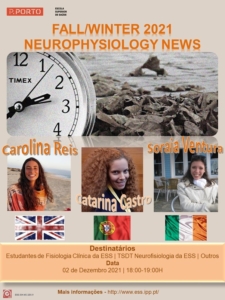
INFANT PhD researcher, Soraia Ventura, will speak at an event aimed at students of clinical physiology and neurophysiology at the Escola Superior de Saúde in Porto, on Thursday 2 December.

Soraia will be speaking about her academic career to date, what it means to be a researcher and the INFANT Research Centre.

The event is the first of a series of seminars organised by Professor Diana Tavares, coordinator of the undergraduate degree in Clinical Physiology and coordinator of the Neurophysiology department at the School of Health at the Escola Superior de Saúde.

The overall objective of the series is to demystify and open perspectives on research to health students. The event will also see Soraia return to her alma mater, where she completed a B.Sc (Hons) Neurophysiology in 2011.

Soraia joined INFANT in 2017 after working in the Clinical Neurophysiology Department at Cork University Hospital as a Clinical Physiologist in Neurophysiology.

Her PhD project, titled Electroencephalographic Study of Sleep Architecture in Infants at Four Months, aims to understand infant Neurodevelopment through sleep markers and falls within the scope of INFANT’s BabySMART study.

Other speakers at the event include:

Dr. Carolina Reis, researcher at University of Oxford.

Catarina Castro, PhD candidate at Faculty of Medicine at the University of Porto.

PhD Profile: Kaiyu Yu Talks Decision Support Tools for Newborn Brain Protection

By |2021-10-27T14:28:09+01:00October 27th, 2021|

An emerging expert in the field of biomedical engineering, Kaiyu Yu joined INFANT as a PhD researcher in July 2021 to begin working on an SFI Frontiers for the Future project that is developing decision support tools for newborn brain protection at INFANT.

The newborn brain is vulnerable to injury around the time of birth. Decision support systems based on artificial intelligence can turn data from devices that measure vital signals from the brain, heart and circulatory system into information that can help clinicians to treat critically ill infants.

However, these signals are complex and the interaction between them is not completely understood. This project will develop new mathematical and signal processing models that will facilitate the next generation of computer algorithms that will help doctors deliver specific and urgent medical interventions to improve the long-term health and quality of life for these infants.

The ambitious project will lean on Kaiyu’s expertise in developing machine learning algorithms and could help clinicians to monitor, predict and treat low blood pressure among pre-term infants before a serious issue may arise.

Clinicians want to be able to monitor a pre-term baby’s blood pressure. They do this by measuring some physiological signals, such as EEG, ECG and NIRS readings.

I want to be able to develop a system that collates, processes, segments and models EEG, ECG and NIRS data so that clinicians can accurately predict if a pre-term baby’s blood pressure is going to drop to a level that might require medical intervention.

As a master’s student, Kaiyu developed an Android app that collected human activity data while studying biomedical engineering at Dalian University of Technology in China.

Through his expertise in developing machine learning algorithms, Kaiyu could see synergies between his research and the work being undertaken by INFANT’s Dr Gordon Lightbody and Professor Liam Marnane.

After I heard Professor Marnane speak at Dalian University of Technology, I understood that there were synergies between the research that we were both involved in.

As part of my master’s thesis, I was using machine learning models to develop useful tools that could predict health outcomes, which was something that Professor Marnane and INFANT were also engaged with.

So, when I completed my master’s, I email Professor Marnane to see if I could work on a PhD project at INFANT.

Thankfully he said yes, and now I’m applying a lot of what I learned at Dalian in this new project.

Having started the PhD programme, Kaiyu is in the process of surveying data that will eventually help him to design a system that will result in better clinical outcomes for pre-term babies.

That desire drives his ambition to complete the programme so that he can work in the medical industry, where he can help enhance medical devices.


Go to Top