INFANT Designed Brain Injury Detection Device Secures Enterprise Ireland funding

By |2022-02-23T12:23:35+00:00February 23rd, 2022|

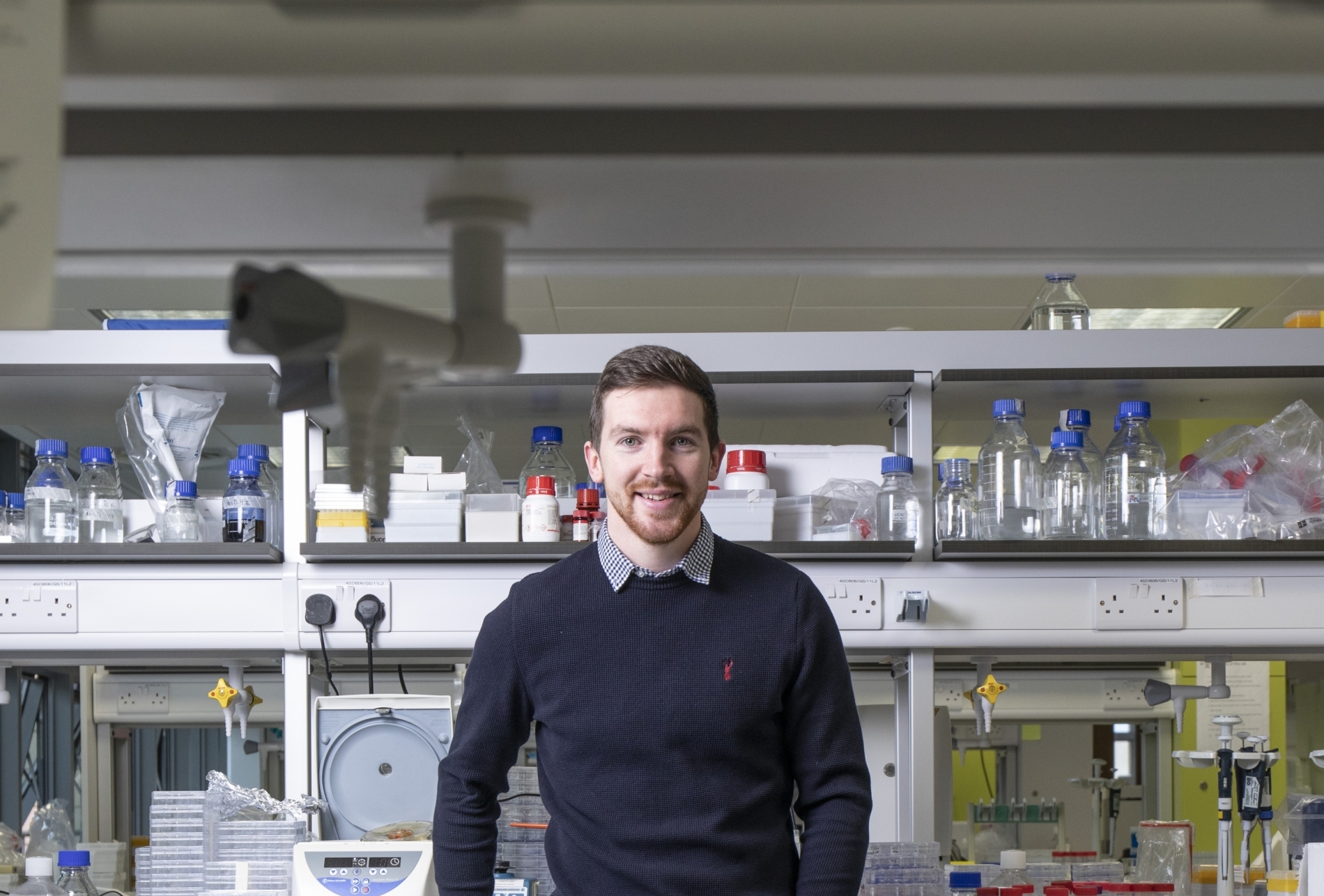
A research team led by University College Cork’s (UCC) Dr Mark O’Sullivan in the INFANT Research Centre has been awarded funding by Enterprise Ireland to commercialise a medical device that could transform how clinicians are able to detect newborn brain injuries.

Presently, brain injuries in newborns account for 23% of all infant deaths and over one million cases of permanent disability each year. Seizures are often the most common diagnostic indication of brain injury. However, accurate diagnosis requires complex equipment and expertise which is not readily available.

The pocket-sized device, which is being developed by the Neurobell team at UCC’s INFANT Research Centre, will allow clinicians to rapidly diagnose potential brain injuries in newborns without requiring the specialised medical expertise needed to configure and manage complex EEG machines.

Dr O’Sullivan, a lead investigator with INFANT, believes that the novel device could potentially be deployed across all hospital settings, ensuring that clinicians could make rapid decisions using its AI-based decision support.

Although EEG is the gold standard for neurological monitoring, they are large complex machines that require specialised personnel to configure the equipment and interpret the hours of resulting EEG information.

This often restricts the use of EEG monitoring to tertiary hospitals, and even in such locations, the expertise is not readily available for EEG to be used routinely without significant delays.

We are building a portable and wireless device that can both record the EEG and provide AI-based detection of seizures.

This will provide clinicians with real time alerts and data, allowing them to quickly diagnose and treat potential brain injuries.

Currently at the prototype stage, the Enterprise Ireland Commercialisation Fund, which is co-funded by the European Regional Development Fund (ERDF), will allow the Neurobell project team to execute on their plans to finalise the design of the medical device this year and to complete a clinical investigation in 2023. The 2 years of funding will be used to hire key engineering, clinical, and commercial personnel and to engage with industry partners. Following the Enterprise Ireland Commercialisation funding, the team plan to establish a spin-out company to bring their novel technology to market.

The device builds on the AI-based research, recently recognised at the AI Awards Ireland, conducted at the INFANT Research Centre and combines multi-disciplinary expertise across medicine, computer science, and engineering.

Once complete, the device could result in positive health outcomes for a significant number of babies born in hospitals that don’t have access to EEG machines and expertise.

The cot side technology that we’re building is designed to allow for the neurological monitoring of newborns, across all hospital settings, helping those in need to be diagnosed and treated in a timely manner.

By developing a portable monitor with on-board decision support, we’re aiming to increase the number of hospitals capable of providing EEG monitoring for high-risk newborns.

The Enterprise Ireland funding underscores INFANT’s ambition to constantly strive and innovate in maternal and child healthcare, an area where there is huge potential and great clinical need according to INFANT Director, Prof Geraldine Boylan.

This technology will be disruptive and provide access for many more hospitals to brain monitoring, without the need for expert training or costly equipment. The potential for translation to low resource settings, where the burden of brain injury is highest is ground-breaking.

Since the inception of the Neurobell project, Dr. O’Sullivan has been supported by UCC Innovation through the GatewayUCC Sprint Accelerator programme and the IGNITE Business Innovation Centre.

INFANT Research Centre wins “Best application of AI in an Academic Research Body” in the National AI Awards 2021

By |2021-11-29T13:06:12+00:00November 26th, 2021|

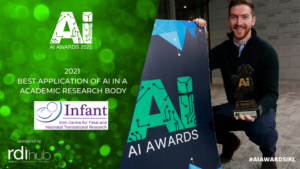
The INFANT Research Centre at University College Cork has won the prestigious “Best application of AI in an Academic Research Body” award at this year’s National AI Awards.

The AI Awards, hosted by AI Ireland and main sponsor Microsoft, are devoted to promoting AI in Ireland, with this year’s “Best application of AI in an Academic Research Body” sponsored by the RDI Hub.

The INFANT Research Centre secured a nomination based on its cutting-edge research and pioneering breakthroughs in using AI technology to detect neurological problems in newborn infants.

Recent advances on the Neurobell project, led by Dr. Mark O’Sullivan, are focused on bringing this disruptive technology toward everyday clinical use.

The project is developing an end‑to-end diagnostics solution, which integrates portable and wireless monitoring with on-board AI, to ensure that it can be rolled out across multiple hospital settings.

EEG monitoring is the gold standard for neurological monitoring, however, it requires specialised expertise to both set up the monitoring systems and to interpret the EEG traces.

According to Dr. O’Sullivan, “by developing a portable monitor with on-board decision support, we’re aiming to increase the number of hospitals capable of providing EEG monitoring for high-risk newborns.

“The cot side technology that we’re building is designed to allow for the neurological monitoring of newborns, across all hospital settings, helping those in need to be diagnosed and treated in a timely manner.

“Given that brain injuries in newborns account for 23% of all infant deaths and over 1 million cases of permanent disability globally each year, the timely and accurate diagnosis of potential issues are essential to provide treatment and help improve patient outcomes.”

The UCC based research centre has now won the award for three consecutive years, demonstrating INFANT’s appetite to constantly innovate and advance this state-of-the-art field.

The award also shines a spotlight on the innovative research being conducted at UCC and reinforces INFANT’s position as leader at the cutting edge of AI.

According to INFANT Director, Prof Geraldine Boylan, “this award highlights how INFANT is constantly striving to innovate in maternal and child healthcare, an area where there is huge potential and great clinical need. The multidisciplinary team approach championed by INFANT has been a key enabler to successful application of our AI solutions. We are very grateful to AI Ireland for this strong endorsement of our work and to Microsoft and EDI Hub for their sponsorship.”

The research being undertaken at the INFANT Research Centre leverages the power of AI and inter-disciplinary research, combining engineering, computer science and clinical expertise to develop a solution that meets the clinical need for a robust neonatal brain monitoring system.

PhD Profile: Kimia Rezaei on Developing Algorithms to Measure Abnormal Biosignals

By |2021-10-22T09:31:25+01:00October 22nd, 2021|

One of five PhD students to begin their studies at INFANT this semester, Kimia Rezaei comes to University College Cork with a great deal of academic and industry experience.

After completing a Masters in electrical engineering at Islamic Azad University in Iran during 2014, Kimia sought out and secured a role with Sahand Parsian Gharb Communication Service Company, where she developed an advanced knowledge of mobile networks and Ericsson’s sophisticated equipment and software.

During that time, Kimia also enhanced her academic profile, publishing three articles in peer reviewed journals.

Focusing each of her publications on the segmentation and classification of brain tumour images using machine learning algorithms, Kimia developed a specialism in a field that naturally aligned with INFANT’s research strengths.

Working under the supervision of Professor Liam Marnane and Dr Gordon Lightbody, Kimia will be given the opportunity to enhance her knowledge and expertise as she seeks to develop an algorithm that will measure the symptoms that trigger abnormal biosignal readings among infants.

Kimia’s PhD project leans on her most recent publication, which demonstrated how radiologists can employ machine learning algorithms and computer-aided diagnosis systems to make more informed medical decisions.

If we can accurately predict abnormal EEG and ECG signals, we can begin to pre-emptively diagnose and treat infants.

To do this, my research aims to accurately measure things like brain activity and blood pressure so that we can collect data that will help us to create an algorithm that will allow clinicians to quickly diagnose, treat and cure children.

I hope that my research will help children to grow up healthy.

Kimia is in the early stages of her study after joining the INFANT team in September. Scheduled to complete the PhD programme in 2025, Kimia is driven by an ambition to work at the intersection between healthcare and technology after she graduates.

Go to Top