Pregnancy loss is common. Workplace support should be too.

By |2026-10-12T11:27:27+01:00October 12th, 2026|

Pregnancy loss is common. Workplace support should be too.

One year after the launch of the Pregnancy Loss & the Workplace Toolkit, employers are putting the research into practice. This Baby Loss Awareness Week (9-15 October), we are encouraging more organisations to do the same.

Pregnancy loss affects approximately one in four pregnancies in Ireland, yet many people experiencing loss have historically had to navigate its physical and emotional impact without dedicated workplace leave or support.

In October 2025, the Pregnancy Loss Research Group at INFANT Research Centre, University College Cork launched the Pregnancy Loss & the Workplace Toolkit to help change that.

Developed from research into people’s experiences of pregnancy loss at work, the free toolkit gives employers practical guidance to put meaningful supports in place, including a template workplace policy, guidance for managers and information for employees.

One year later, organisations are demonstrating just how quickly that research can translate into change.


From livid experience to change within a month

For Cork mother Diane Magee, the need for better workplace support is deeply personal.

Diane has experienced pregnancy loss at different stages of pregnancy, alongside IVF treatment and the complex journey of trying to conceive again after loss.

“Pregnancy loss can bring grief and physical recovery, but there can also be enormous emotional, financial and relationship pressures,” Diane said.

“Having a supportive workplace and knowing there is a policy there if you need it can take a huge weight off someone at an incredibly difficult time.”

Diane contributed her lived experience to the development of the Pregnancy Loss & the Workplace Toolkit because she wanted workplaces to better recognise pregnancy loss as a genuine loss, and give people the time, understanding and support they may need.

After the toolkit was launched, Diane brought it to her own employer, Marymount University Hospital and Hospice.

In less than a month, Marymount had introduced dedicated pregnancy loss leave.

Christine O’Riordan, Staff Support and Wellbeing Officer at Marymount, said having practical guidance and policy language available through the toolkit made it straightforward for the organisation to act.

“When someone is going through pregnancy loss, there is so much they are already trying to process. If we can take just one worry off their plate by making sure they don’t have to worry about work, that can make a world of difference. For us, putting that support in place was a relatively simple step, but it can mean so much to the person who needs it.”

Employees have since used the leave – something Christine describes as an “absolute success”.


Turning guidance into practical support

Marymount isn’t alone. Gas Networks Ireland has also used the toolkit to help develop its own pregnancy loss policy.

The organisation introduced dedicated leave, guidance for managers and different ways for employees to access support. The policy recognises fathers and partners too, while mandatory training helps managers understand how to respond sensitively when an employee experiences pregnancy loss.

Employees are now using the leave, feedback has been positive and other organisations have approached Gas Networks Ireland to learn from its experience.

For Nicola McSweeney, Director of People at Gas Networks Ireland, putting these supports in place is a simple but important part of creating a workplace where employees know they will be supported when difficult things happen.

“There really is no downside to putting these supports in place. People will experience difficult things in their lives, and as an employer we want them to know that when they do, they will be supported. A clear policy also gives managers confidence – they don’t need to have all the answers; they need to listen and know what support is available.”


Could your workplace be next?

For Professor Keelin O’Donoghue, who leads the Pregnancy Loss Research Group and is Clinical Lead for Obstetric Research at INFANT Research Centre, the experience of Marymount and Gas Networks Ireland demonstrates what employers can do now.

“Supporting people through pregnancy loss in the workplace goes beyond an entitlement to time off. Clear policies, informed and supported managers, and a compassionate workplace culture can make an enormous difference to someone’s experience.”

While pregnancy loss leave is also moving up the national policy agenda, with the Government approving the drafting of legislation earlier this year, employers do not need to wait for statutory change to put meaningful supports in place.


This Baby Loss Awareness Week, we are encouraging employers to take a simple first step:

Download the toolkit. Share it with your HR team or leadership. Ask what your organisation can put in place.

The resources are free, practical and designed so organisations do not have to start from scratch.

Pregnancy loss is common. Workplace support should be too.

Download the Pregnancy Loss & the Workplace Toolkit

IRC Government of Ireland Postdoctoral Fellowship and Postgraduate Scholarship Awardees

By |2023-09-15T14:13:34+01:00September 14th, 2023|

Three INFANT researchers received IRC Government of Ireland Postdoctoral Fellowship and Postgraduate Scholarship Awards.

Minister Simon Harris announced €24.6 million in Irish Research Council funding to support rising researchers and pioneering projects. “I am delighted to announce this investment for a new generation of postgraduate and postdoctoral researchers under the Irish Research Council’s Government of Ireland programmes. These awards will support the development of the next generation of excellent researchers in Ireland, as they pursue new knowledge at the cutting edge of a wide range of disciplines”.

Postdoctoral Fellowship Awardees: 

Marita Hennessy is a Postdoctoral Researcher at INFANT (Pregnancy Loss Research Group). During her two-year fellowship, Marita will develop and pilot test a psychosocial intervention for staff in maternity hospitals/units in Ireland under the mentorship of INFANT PI, Professor Keelin O’Donoghue.

Gillian Maher is a Postdoctoral Researcher at INFANT. During her two-year fellowship, Gillian will develop a novel approach to harness Irish maternal and newborn data to improve pregnancy outcomes for mothers and babies.

Postgraduate Scholarship Awardee: 

Aoife Gallagher is a Clinical Research Fellow with an interest in Pediatric Allergy and Immunology. During her 12-month scholarship she will be working on ARChhIE: A Retrospective Comparison of Irish and Spanish IgE- Medi-ated Egg Allergy Strategies.

Welcoming the announcement, Peter Brown, Director of the Irish Research Council, said: “Early-career researchers represent the future of research and innovation and the funding being announced by the Minister today will support a vibrant knowledge eco-system. This eco-system will benefit and shape the further development of enterprise, public policy and our higher education institutions”.

INFANT PhD student received Fellowship of the Royal College of Pathologists

By |2023-09-15T09:48:59+01:00September 12th, 2023|

Huge congratulations to INFANT PhD student Caroline Joyce on receiving her Fellowship of the Royal College of Pathologists.

Caroline’s PhD work is on the identification of Biomarkers for the Diagnosis, Management and Follow-up of Women with Gestational Trophoblastic Disease. This project aims to identify more sensitive biomarkers for GTD to allow earlier detection of disease recurrence and progression to malignant disease.

🔗 More info: Biomarkers for Gestational Trophoblastic Disease | University College Cork (ucc.ie)

This is a collaborative project between INFANT – Pregnancy Loss Research Group (PLRG) (Prof. Keelin O’Donoghue), the School of Biochemistry & Cell Biology (Prof. Tommie McCarthy) and the National Trophoblastic Disease Centre (Dr John Coulter).

INFANT PI, Prof Keelin O’Donoghue awarded Distinguished Researcher Award

By |2023-08-01T13:15:38+01:00July 6th, 2023|

INFANT PI, Professor Keelin O’Donoghue was awarded the International Stillbirth Alliance (ISA) Distinguished Researcher Award for her contribution or her contribution to research on stillbirth/newborn death. The award was conferred at the closing ceremony of the 2023 conference, hosted at the University of Sheffield from 30 June to 02 July.

Announcing the award, Professor Adrienne Gordon said: “She has been awarded this on the unanimous decision by the Board to reflect her years of significant research around stillbirth, most particularly in Ireland where she is continuing to strive for best practice care for families and high quality evidence, particularly in terms of the national standards, so we thank you Keelin for all that you do.”

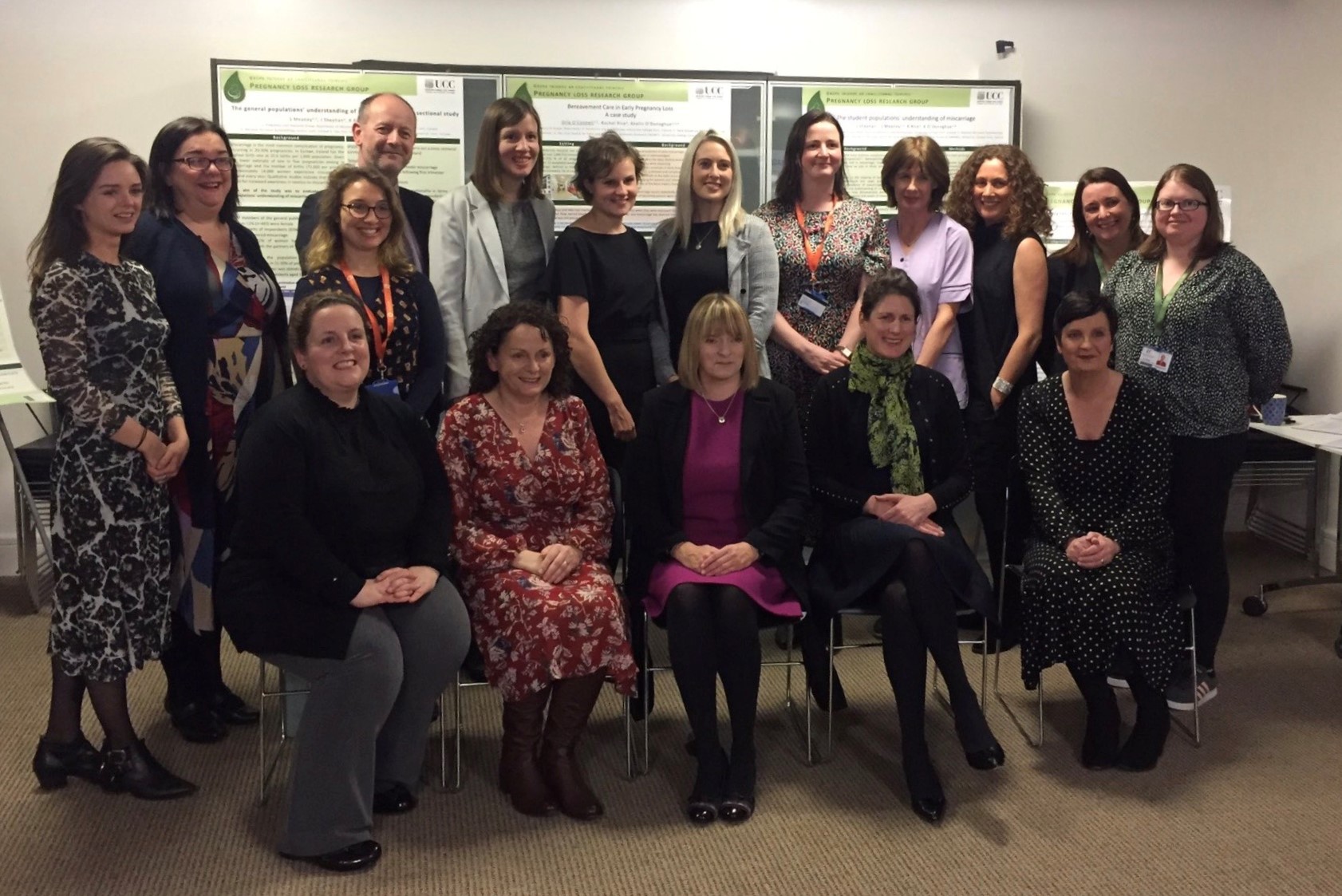
Professor O’Donoghue, along with 11 other members of the Pregnancy Loss Research Group, attended the International Stillbirth Alliance (ISA) Conference 2023 at The University of Sheffield from 30 June to 02 July, showcasing a variety of work undertaken by the Group in the areas of:

Source: News and media | University College Cork (ucc.ie)

PhD Profile: Tamara Escañuela Sánchez’s Study to Raise Awareness of and Reduce the Risk Factors Connected with Stillbirth

By |2022-03-30T15:09:53+01:00March 30th, 2022|

A graduate of the Universitat Autònoma de Barcelona, INFANT PhD candidate, Tamara Escañuela Sánchez came to University College Cork to study under Professor Keelin O’Donoghue and develop a behaviour change intervention model that will raise awareness of and reduce the risk factors associated with stillbirth in Ireland.

Tamara’s multidisciplinary supervisory team is composed by Dr. Karen Matvienko-Sikar from the School of Public Health in UCC; Dr. Sarah Meaney, from the National Perinatal Epidemiology Centre; Professor Molly Byrne lead of the Health Behaviour Change Research Group, School of Psychology at NUI Galway and Professor Keelin O’Donoghue lead of the Pregnancy Loss Research Group at Cork University Maternity Hospital.

Funded by Science Foundation Ireland, Tamara’s research, titled The Relevant Study, examines the risk factors connected with stillbirth and ill health in babies such as substance abuse, sleep position, weight management and engagement with antenatal care.

Ultimately, Tamara hopes that her study might one day lead to the introduction of an initiative, similar to the Saving Babies’ Lives Care Bundle introduced by the NHS in the UK, that targets the modifiable risk factors for stillbirth in Ireland.

I have been looking at various studies that examine the different risk factors associated with still births.

The factors that I’m focussing on are substance abuse, sleep position, weight management and engagement with antenatal care services.

Changing behaviours associated with those factors could have a very real impact for women and their children.

My research looks at ways in which we might change those behaviours, the idea would be that we’d eventually create a care bundle like they have in the UK and Australia.

As part of her study, Tamara also reviewed pregnancy-related websites to assess the reliability of information connecting risk factors to stillbirths or ill health in babies.

Her findings, published in the Journal of Communication in Healthcare, highlighted the scarcity of information online and the need for greater communication so that women can identify the risk factors associated with stillbirths.

We looked at pregnancy related websites in the UK and Ireland and found that only one contained information relevant to the risk factors connected with stillbirths.

We also found that websites hosted by charities were more likely to contain basic information related to stillbirth, whereas commercial sites were more likely to contain information about modifiable risk factors.

It really illustrated the need for reliable sources of information so that women can make informed decisions.

As Tamara comes to the end of her study, she hopes to conclude her PhD research by summarising the challenges facing women who are looking to access relevant information on the risk factors associated with stillbirth.

By developing a list of recommendations, she also hopes that future researchers will be able to build on her study and develop a pilot intervention strategy that allows health authorities to target behaviours that contribute to stillbirth.

Pregnancy Loss Research Group Secures IRC funding to Enhance the Translation of Pregnancy Loss Research into Policy and Practice

By |2022-01-17T10:32:03+00:00January 17th, 2022|

Professor Keelin O’Donoghue, Lead of the Pregnancy Loss Research Group, together with the Irish Hospice Foundation as civic society partner, has been awarded an Irish Research Council New Foundations Award 2021 to enhance the translation of pregnancy loss research into policy and practice through a project titled PLATFORM: Pregnancy Loss knowledge trAnslaTion FOR iMpact.

The project will bring researchers, key civil society partners and other knowledge users – including parent advocates – together to identify barriers and facilitators to knowledge translation, and develop activities and outputs in an effort to address the decades-long lack of progress in implementing change at policy and practice levels. PLATFORM will contribute to enhancing Irish public and policymaker awareness of pregnancy loss, provision of more effective services/supports within the health care system, community sector, and beyond, and influencing policymaking and healthcare funding. The project was developed in part following input from parent advocates on public and patient involvement group for an ongoing research project (RE:CURRENT); they voiced the need for parents to hear about pregnancy loss research that is being undertaken, as often they feel that it is a neglected area.

Announcing the New Foundations 2021 recipients, Director of the Irish Research Council, Peter Brown, said: “In addition to the 55 projects announced today that will collaborate with civic society partners, we are also delighted to renew our ongoing partnerships with government departments and agencies. This form of collaboration provides excellent opportunities for researchers to contribute to evidence-based policymaking, resulting in better outcomes for society and citizens in the face of many national and global challenges”.

The project is funded under Strand 1a: Enhancing Civic Society within a national context, which supports small, discrete collaborative projects between researchers and civic society groups in the community and voluntary sector.

Professor O’ Donoghue is a Consultant Obstetrician and Maternal-Fetal Medicine Sub-Specialist at Cork University Maternity Hospital and is actively engaged in impactful research, teaching and clinical practice. She leads the multi-disciplinary Pregnancy Loss Research Group, which comprises over 30 members, at all career stages.

The Irish Hospice Foundation, the national charity that addresses dying, death and bereavement in Ireland, by promoting awareness and developing programmes in education, research and bereavement services.

The Pregnancy Loss Research Group and the Irish Hospice Foundation have collaborated on several improvement projects to-date, including the implementation of the National Standards for Bereavement Care Following Pregnancy Loss and Perinatal Death. One of the implementation activities involved the development of a national website (www.pregnancyandinfantloss.ie), a repository of information for bereaved parents and healthcare staff about pregnancy and infant loss. They have also worked together on national education programmes for hospital staff.

Follow updates on Twitter (@PregnancyLossIE #PLRG_PLATFORM ) and the PLRG and INFANT websites.

INFANT PI and Pregnancy Loss Research Group Lead, Professor Keelin O’Donoghue, wins Irish Research Council Research Ally Prize

By |2021-12-03T14:14:41+00:00December 3rd, 2021|

Professor Keelin O’Donoghue, has been awarded a Research Ally Prize as part of the Irish Research Council Researcher of the Year 2021 awards for the positive impact that she has made as a mentor.

Announcing this year’s winners, Director of the Irish Research Council, Peter Brown, said: “I would like to congratulate the awardees on their awards. The standard of nominations this year was extremely high, and each of the winners should be immensely proud of their achievements. It is great to see this year’s winners representing a diverse range of research interests, which reflects the creativity and dynamism of the research community here in Ireland.”

Professor O’ Donoghue is a Consultant Obstetrician and Maternal-Fetal Medicine Sub-Specialist at Cork University Maternity Hospital and is actively engaged in impactful research, teaching and clinical practice. She leads the multi-disciplinary Pregnancy Loss Research Group, which comprises over 30 members, at all career stages. She has extensive supervisory/mentorship experience, with numerous researchers having completed/ongoing studies with her support, under a variety of programmes: PhD, Masters by research, MSc Public Health, MD, MSc Obstetrics & Gynaecology, Diploma Obstetrics & Gynaecology, and postdoctoral.

Professor O’Donoghue is one of ten 10 UCC winners of the Irish Research Council Research Ally Prizes. The Research Ally Prizes celebrate the role of supervisors, mentors, and research officers in supporting and sustaining the Irish research community, and how they help to foster a positive academic culture based on equality, inclusivity, and respect.

Pregnancy Loss Research From Ireland Well-Represented at Upcoming ISA-ISPID Conference

By |2021-11-09T10:43:23+00:00November 9th, 2021|

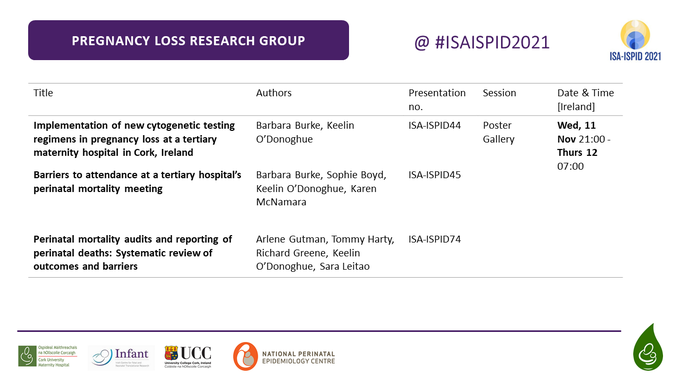
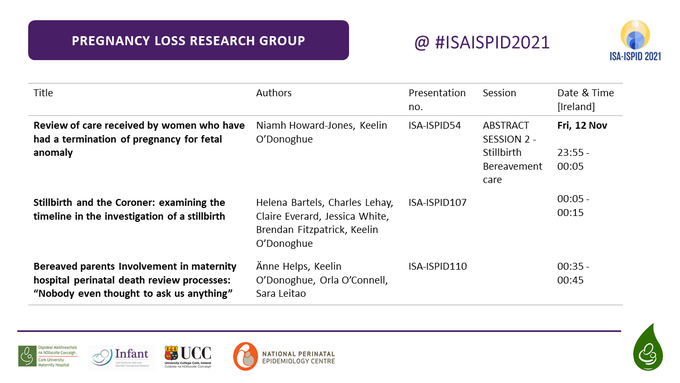
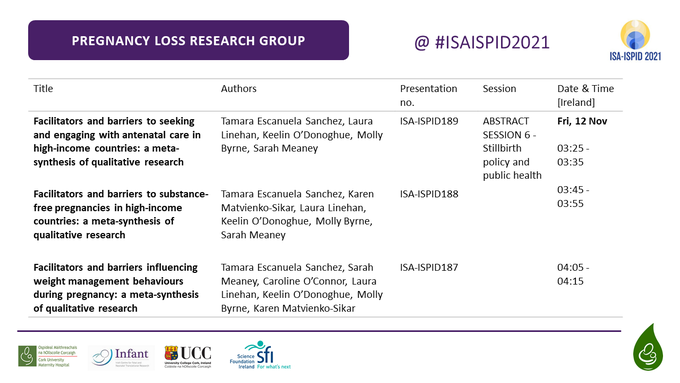
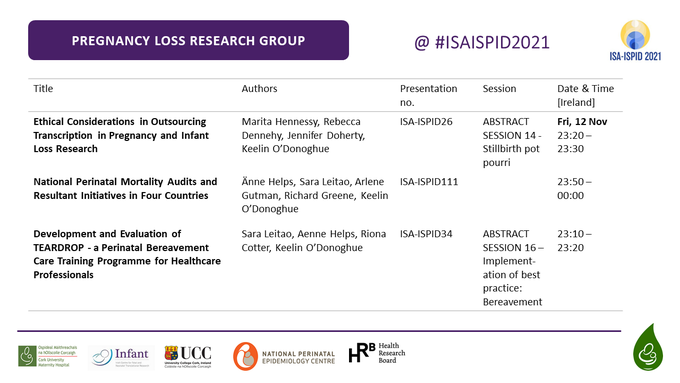
Researchers from the Pregnancy Loss Research Group, comprising staff from INFANT, UCC College of Medicine and Health and the National Perinatal Epidemiology Centre, will present a range of their work at the 2021 ISA-ISPID Conference which takes place virtually from 11-13 November 2021. 

The twelve presentations – details below – showcase the breadth of research areas within the Group, including perinatal mortality audits/reporting (including parental involvement) and coronial processes, termination of pregnancy, stillbirth prevention (including barriers and facilitators to engaging in antenatal care, substance-free pregnancies and weight management), education programmes for healthcare professionals. They also represent research conducted through a range of funding partners, including Science Foundation Ireland and the Health Research Board, and collaborations with Groups/Centres such as the National Perinatal Epidemiology Centre and the Health Behaviour Change Research Group, NUI Galway. 

Speaking about the conference, Professor Keelin O’Donoghue who leads the Pregnancy Loss Research Group, said:  

“The ISA and ISA-ISPID conferences are important annual events for our Group, and which we have actively participated in since 2010. They enable us to communicate our research on an international stage and engage in discussion, shared learning, and knowledge exchange with bereaved parents, support groups, clinicians, researchers and policymakers. This strengthens our efforts, and collaborative activities, in the prevention of stillbirth, in understanding its impact and in improving bereavement care”.  

ISA-ISPID 2021 is hosted by the International Stillbirth Alliance (ISA) and the International Society for the study and prevention of Perinatal and Infant Death (ISPID), in conjunction with the Australian Centre of Research Excellence in Stillbirth and PSANZ. This year’s conference theme is Driving Change: it will address global issues of stillbirth, neonatal death, SIDS, and Sudden Unexpected Death in Infancy (SUDI) and showcase strategies to address these issues across high, middle and low-income countries. 

The Pregnancy Loss Research Group hosted the annual meeting of the International Stillbirth Alliance in 2017. This commentary, published in Research Involvement and Engagement, describes the collaboration taken by clinicians, researchers and bereaved parents to ensure that the voice of parents could contribute to the research agenda and developments in preventing stillbirth and improving bereavement care. 

Presentation details 

Image

Image

Image

Image

Go to Top