About Comms

This author has not yet filled in any details.
So far Comms has created 393 blog entries.

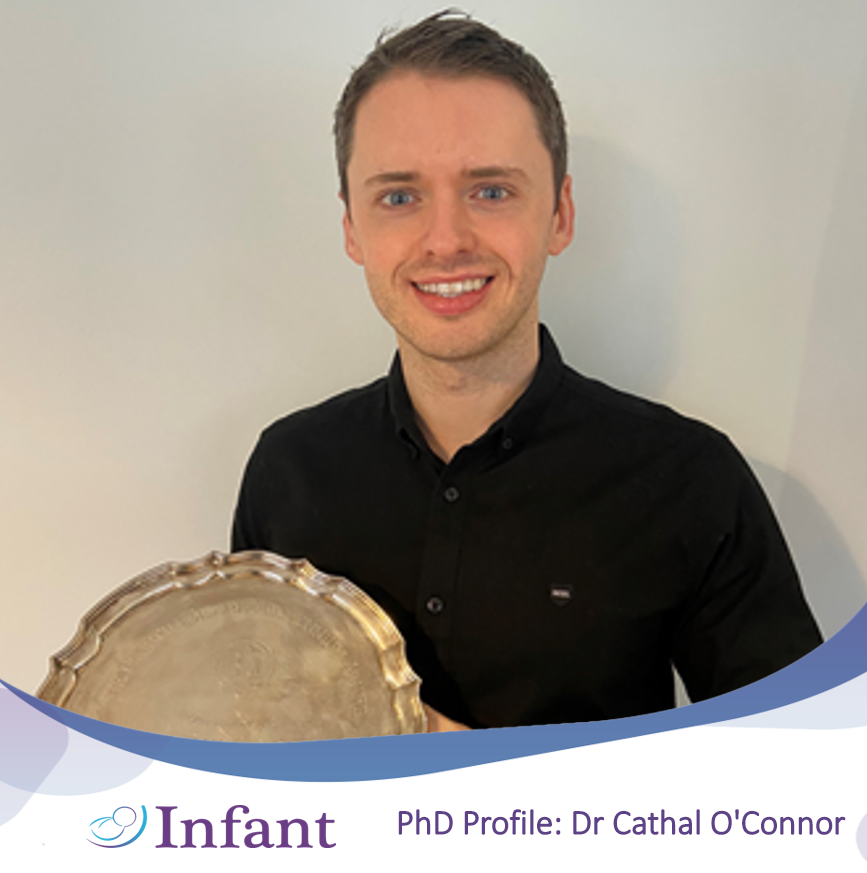
PhD Profile: Dr Cathal O’Connor’s work to investigate the impact of eczema on babies’ sleep
By |2022-08-08T15:59:13+01:00August 8th, 2022|

Cathal O’Connor is a PhD fellow with the prestigious Irish Clinical and Academic Training (ICAT) programme and is a Specialist Registrar in Dermatology with the Royal College of Physicians of Ireland (RCPI), dual training in general paediatrics. He graduated from University College Cork in 2013 and undertook Basic Specialist Training with RCPI in both Paediatrics and Adult Medicine. He has dual membership of the RCPI in Paediatrics (2015) and Medicine (2017). He is author of several dermatology textbook chapters, has over 50 academic publications and has a special interest in paediatric dermatology, with primary research interests including eczema and genetic skin disease. He has been chosen as a ‘Future Leader’ by the executive board of the European Society for Paediatric Dermatology for 2021-2024.

Assessing SleeP IN infants with early-onset atopic Dermatitis by Longitudinal Evaluation (The SPINDLE study)

The aim of the project is to describe, for the first time, detailed sleep architecture of infants with early-onset atopic dermatitis (AD), also known as eczema, compared to controls, by using EEG polysomnography, sleep actigraphy, and parental reporting.

The objectives are to:

1. Recruit a cohort of infants with early-onset AD and a cohort of matched healthy controls

2. Collect and analyse parent-reported, actigraphy, and EEG polysomnography sleep data from infants with early-onset AD, and compare to healthy controls

3. Perform serial clinical assessment, skin barrier assessment, and inflammatory cytokine assessment (by tape stripping), and correlate with sleep features in infants with early-onset AD

4. Examine sleep and quality of life indices of caregivers of infants with early-onset AD compared to controls

Cathal has seen first-hand the massive impact that eczema has on families, and hopes to improves outcomes for babies and families with this research. His primary supervisor is Prof Geraldine Boylan, who is a global expert on EEGs and sleep research in babies.

https://bmcpediatr.biomedcentral.com/articles/10.1186/s12887-022-03382-3


Supervisors/advisors: Prof Alan D. Irvine, Prof Deirdre Murray, Dr Michelle Murphy, Prof Jonathan O’B Hourihane & Prof Geraldine Boylan
The NOAH Study – Update

By |2022-08-08T12:20:45+01:00August 8th, 2022|

🗣️Our Study – The NOAH Study (Noninvasive objective assessment of heamodynamics) is half way through!

💡Learn more about the NOAH study and read some of the papers published here:

🔎https://infantcentre.ie/noah/


PhD Profile: Fabio Magarelli

By |2022-08-02T08:53:24+01:00August 2nd, 2022|


Fabio, is a first-year PhD student at the Centre for Research Training in Artificial Intelligence, University College Cork.

His research is in the field of EEG data analysis and applied Machine Learning (ML) which is a subfield of Artificial Intelligence applied to Medicine that is concerned with tools and techniques to produce diagnostic instruments for clinicians in the field of Paediatrics such as EEG abnormalities and patterns detection.

Fabio holds a BSc. In Nursing and an MSc. in Computer Science. Prior to joining the CRT-AI funded PhD programme, Fabio worked as a Research Assistant on the Delphi project at Infant Research Centre in Cork University Hospital. The project aimed to produce a ML model to detect and classify Hypoxic Ischemic Encephalopathy (HIE) in EEG data of term babies. Fabio has also experience working as a Nurse, both in Beaumont Hospital (Dublin) and the Italian Red Cross, and as a Software Developer in University College Dublin (UCD). In his spare time, Fabio enjoys DIY, software development and electronics.


Fabio’s planned thesis title is: “Machine Learning for the prediction of seizures in neonates”

Neonatal seizures are a relatively common occurrence within the first days of life. They can result in highly debilitating and long-lasting injuries for the patient. However, neonatal seizures’ often sudden and subclinical nature makes it more challenging for clinicians to diagnose and take timely action having to rely solely on EEG interpretation in a fast-paced and evolving clinical setting.


The PhD study aims to address the lack of neonatal seizure prediction algorithms using Machine Learning (ML).


The advantage of an ML approach is twofold: first, by extracting all relevant information, which is often not possible in a manual or visual process; and second, these methods lead to an automated solution that could be integrated cot side for continuous, around the clock monitoring. While seizure prediction is still a novel field, this research aims to build on the current knowledge in seizure detection and severity classification of abnormal EEG, to identify patterns indicative of seizure events and exploit any significant correlation with diverse clinical data.


Fabio is a strong advocate of open and organised data sharing within research centres. For this reason, some

of the early efforts  of his PhD have been on developing a ML competition platform and running a ML

Competition for the Classification of Abnormal EEG Background Activity in Newborn Infants, available at

infantresearchcommunity.ucc.ie [1][2]


[1] John M. O’Toole et al. Neonatal EEG Graded for Severity of Background Abnormalities. Version 1.0. Zenodo, May2022. DOI: 10.5281/zenodo.6587973. URL: https://doi.org/10.5281/zenodo.6587973.[2] John M O’Toole et al. Neonatal EEG graded for severity of background abnormalities in hypoxic-ischaemic encephalopa-thy. 2022. DOI: 10.48550/ARXIV.2206.04420. URL: https://arxiv.org/abs/2206.04420.


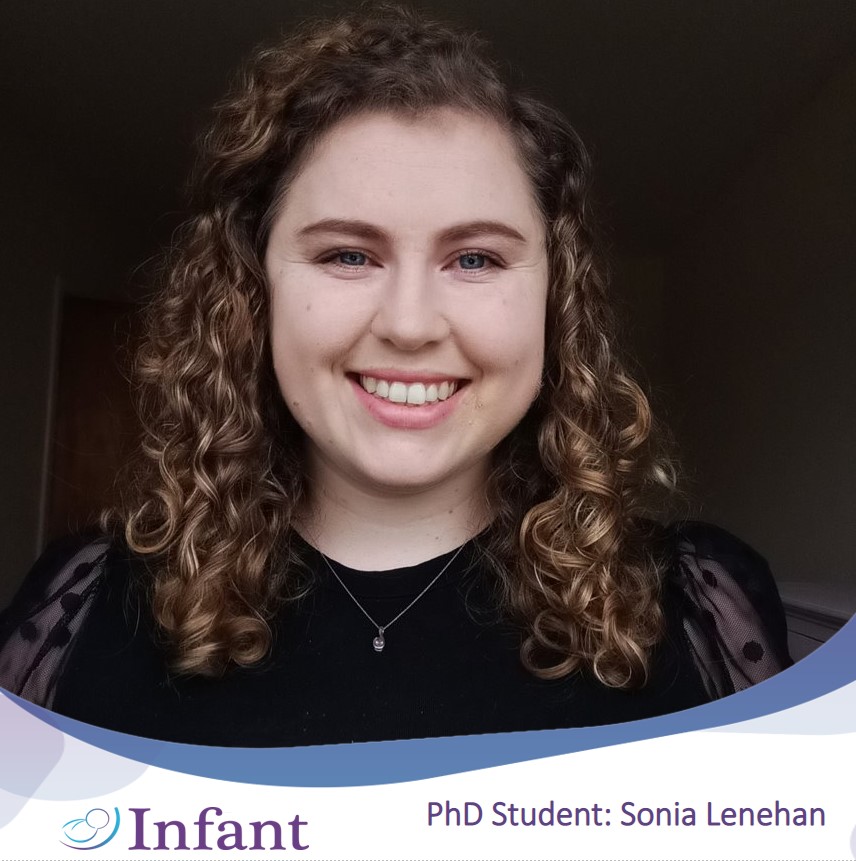
PhD Profile: Sonia Lenehan

By |2022-07-27T14:23:29+01:00July 27th, 2022|

INFANT PhD profile: The INNOVATE study: INvestigatiNg cOgnitive deVelopment in preterm & full-term infAnTs using Eye-tracking

Sonia Lenehan is pursuing a PhD in neurodevelopment and the environment, as well as investigating eye-tracking as an assessment tool in 18-month-old infants. Sonia completed her BSc Neuroscience in UCC in 2016. She began her PhD with the INFANT centre in 2017 looking at how the environment affects neurodevelopment. The project has looked at nutrition, massage, and moderate-to-late preterm birth with a large part of her PhD looking at the INNOVATE studying and investigating the feasibility of eye-tracking as an assessment tool.

Sonia’s planned thesis title is: Investigating the effect of breastfeeding, massage, and moderate-to-late premature birth on the developing brain.

The objectives of this thesis are:

1. To investigate the effect breastfeeding at two months has on the cognitive outcome at five years.

2. To conduct a systematic review to answer the research question: Does the development of social cognition in moderate to late preterm differ from that in term infants?

3. To explore eye-tracking as a measure of cognition in term 18-month olds.

4. To correlate the measure of eye-tracking with the Griffith-III Neurodevelopmental Assessment.

5. To investigate if the development of cognition differs between late preterm and term infants at 18 months of age, as measured by eye-tracking.

In 2020 Sonia was an Irish Research Council Awardee which funded her research until 2021 when she began her new role as the project manager of Science4SightLoss.

As Sonia comes to the end of her PhD, she hopes that this research will have provided an extra tool in the toolbox for assessing children around the world.

European Academy of Allergy and Clinical Immunology – Hybrid Congress 2022

By |2022-07-19T11:13:12+01:00July 19th, 2022|

📢INFANT Research Centre was at the European Academy of Allergy and Clinical Immunology – EAACI HQ Hybrid Congress 2022

🗣️Dr Juan Enrique Trujillo Wurttele presented the e-poster:

💡’A decade of milk ladder in Cork University Hospital: are we achieving our goals?’

🗣️Caoimhe Cronin presented the e-poster:
 
💡’Brands of Adrenaline Auto Injector in Ireland: What Brands do Caregivers use and are they Adequately Trained in their Administration? ‘

University College Cork #Immunology #UCCResearch

Go to Top